Observability for AWS Bedrock with Opik
AWS Bedrock is a fully managed service that provides access to high-performing foundation models (FMs) from leading AI companies like AI21 Labs, Anthropic, Cohere, Meta, Mistral AI, Stability AI, and Amazon through a single API.
This guide explains how to integrate Opik with the Bedrock Python SDK, supporting both the Converse API and the Invoke Model API. By using the track_bedrock method provided by Opik, you can easily track and evaluate your Bedrock API calls within your Opik projects as Opik will automatically log the input prompt, model used, token usage, and response generated.
Account Setup
Section titled “Account Setup”Comet provides a hosted version of the Opik platform, simply create an account and grab your API Key.
You can also run the Opik platform locally, see the installation guide for more information.
Getting Started
Section titled “Getting Started”Installation
Section titled “Installation”To start tracking your Bedrock LLM calls, you'll need to have both the opik and boto3 packages. You can install them using pip:
pip install opik boto3Configuring Opik
Section titled “Configuring Opik”Configure the Opik Python SDK for your deployment type. See the Python SDK Configuration guide for detailed instructions on:
- CLI configuration:
opik configure - Code configuration:
opik.configure() - Self-hosted vs Cloud vs Enterprise setup
- Configuration files and environment variables
Configuring Bedrock
Section titled “Configuring Bedrock”In order to configure Bedrock, you will need to have:
- Your AWS Credentials configured for boto, see the following documentation page for how to set them up.
- Access to the model you are planning to use, see the following documentation page how to do so.
You can request access to models in the AWS Bedrock console.
Once you have these, you can create your boto3 client:
import boto3

REGION = "us-east-1"
MODEL_ID = "us.meta.llama3-2-3b-instruct-v1:0"

bedrock_client = boto3.client(
    service_name="bedrock-runtime",
    region_name=REGION,
    # aws_access_key_id=ACCESS_KEY,
    # aws_secret_access_key=SECRET_KEY,
    # aws_session_token=SESSION_TOKEN,
)
Logging LLM calls
Section titled “Logging LLM calls”Opik supports both AWS Bedrock APIs: the Converse API (unified interface) and the Invoke Model API (model-specific formats). To log LLM calls to Opik, wrap your boto3 client with track_bedrock:
import os
from opik.integrations.bedrock import track_bedrock

# Set project name via environment variable
os.environ["OPIK_PROJECT_NAME"] = "bedrock-integration-demo"

bedrock_client = track_bedrock(bedrock_client)Converse API (Unified Interface)
Section titled “Converse API (Unified Interface)”The Converse API provides a unified interface across all supported models:
import os
import boto3
from opik.integrations.bedrock import track_bedrock

# Set project name via environment variable
os.environ["OPIK_PROJECT_NAME"] = "bedrock-integration-demo"

# Initialize and track the Bedrock client
bedrock_client = boto3.client("bedrock-runtime", region_name="us-east-1")
bedrock_client = track_bedrock(bedrock_client)

PROMPT = "Why is it important to use a LLM Monitoring like CometML Opik tool that allows you to log traces and spans when working with LLM Models hosted on AWS Bedrock?"

response = bedrock_client.converse(
    modelId="us.meta.llama3-2-3b-instruct-v1:0",
    messages=[{"role": "user", "content": [{"text": PROMPT}]}],
    inferenceConfig={"temperature": 0.5, "maxTokens": 512, "topP": 0.9},
)
print("Response", response["output"]["message"]["content"][0]["text"])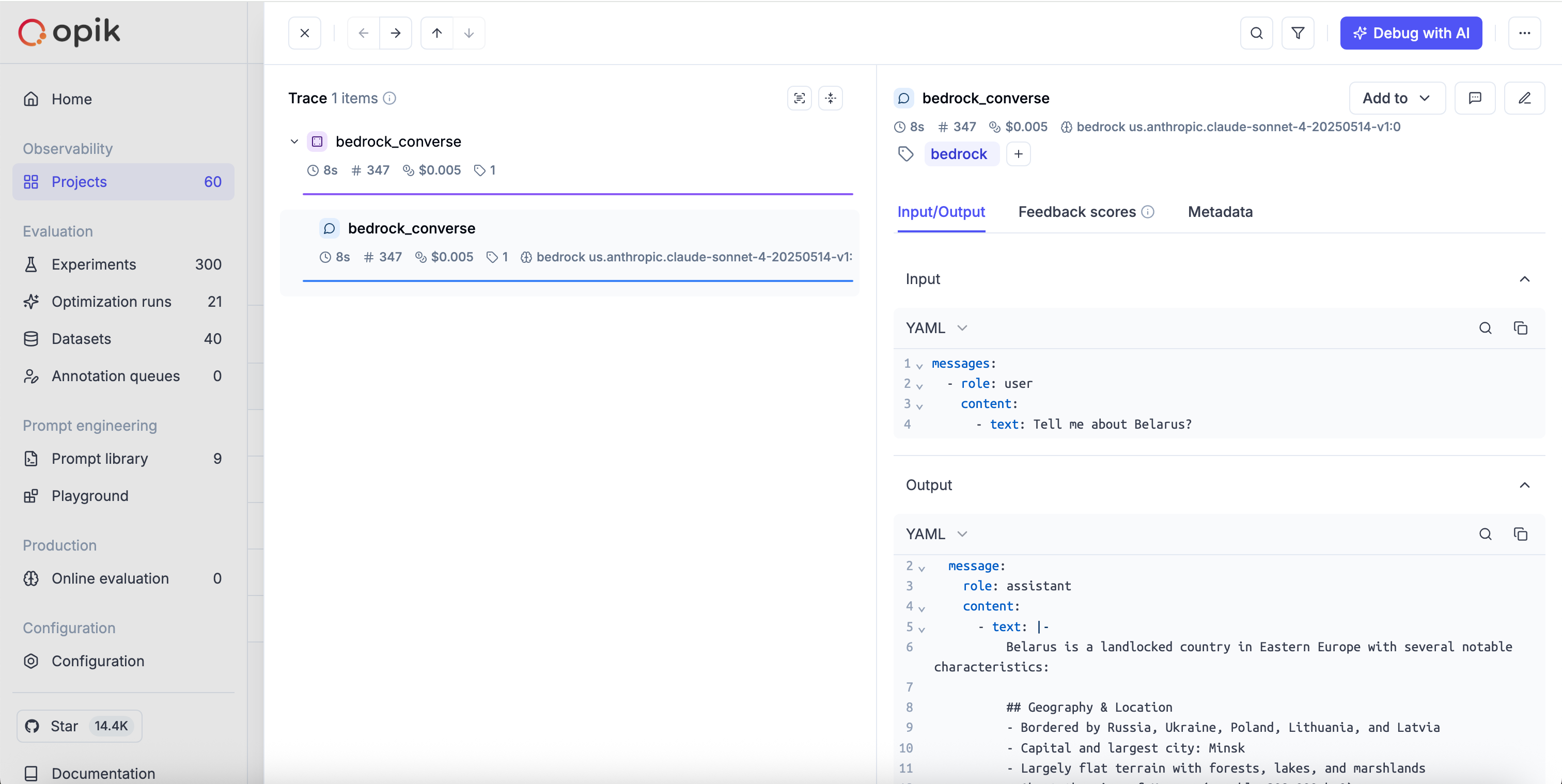
Invoke Model API (Model-Specific Formats)
Section titled “Invoke Model API (Model-Specific Formats)”The Invoke Model API uses model-specific request and response formats. Here are examples for different providers:
import json
import os
import boto3
from opik.integrations.bedrock import track_bedrock

# Set project name via environment variable
os.environ["OPIK_PROJECT_NAME"] = "bedrock-integration-demo"

# Initialize and track the Bedrock client
bedrock_client = boto3.client("bedrock-runtime", region_name="us-east-1")
bedrock_client = track_bedrock(bedrock_client)

# Claude models use Anthropic's message format
request_body = {
    "anthropic_version": "bedrock-2023-05-31",
    "max_tokens": 1000,
    "temperature": 0.7,
    "messages": [
        {
            "role": "user",
            "content": "Explain the benefits of LLM observability"
        }
    ]
}

response = bedrock_client.invoke_model(
    modelId="us.anthropic.claude-3-5-sonnet-20241022-v2:0",
    body=json.dumps(request_body),
    contentType="application/json",
    accept="application/json"
)

response_body = json.loads(response["body"].read())
print("Response:", response_body["content"][0]["text"])import json
import os
import boto3
from opik.integrations.bedrock import track_bedrock
# Set project name via environment variable
os.environ["OPIK_PROJECT_NAME"] = "bedrock-integration-demo"
# Initialize and track the Bedrock client
bedrock_client = boto3.client("bedrock-runtime", region_name="us-east-1")
bedrock_client = track_bedrock(bedrock_client)
# Nova models use Amazon's nested content format
request_body = {
"messages": [
{
"role": "user",
"content": [
{
"text": "Explain the benefits of LLM observability"
}
]
}
],
"inferenceConfig": {
"max_new_tokens": 1000,
"temperature": 0.7
}
}
response = bedrock_client.invoke_model(
modelId="us.amazon.nova-pro-v1:0",
body=json.dumps(request_body),
contentType="application/json",
accept="application/json"
)
response_body = json.loads(response["body"].read())
print("Response:", response_body["output"]["message"]["content"][0]["text"])import json
import os
import boto3
from opik.integrations.bedrock import track_bedrock
# Set project name via environment variable
os.environ["OPIK_PROJECT_NAME"] = "bedrock-integration-demo"
# Initialize and track the Bedrock client
bedrock_client = boto3.client("bedrock-runtime", region_name="us-east-1")
bedrock_client = track_bedrock(bedrock_client)
# Llama models use prompt-based format with special tokens
request_body = {
"prompt": "<|begin_of_text|><|start_header_id|>user<|end_header_id|>\n\nExplain the benefits of LLM observability<|eot_id|><|start_header_id|>assistant<|end_header_id|>\n\n",
"max_gen_len": 1000,
"temperature": 0.7,
"top_p": 0.9
}
response = bedrock_client.invoke_model(
modelId="us.meta.llama3-1-8b-instruct-v1:0",
body=json.dumps(request_body),
contentType="application/json",
accept="application/json"
)
response_body = json.loads(response["body"].read())
print("Response:", response_body["generation"])import json
import os
import boto3
from opik.integrations.bedrock import track_bedrock
# Set project name via environment variable
os.environ["OPIK_PROJECT_NAME"] = "bedrock-integration-demo"
# Initialize and track the Bedrock client
bedrock_client = boto3.client("bedrock-runtime", region_name="us-east-1")
bedrock_client = track_bedrock(bedrock_client)
# Mistral models use OpenAI-like message format
request_body = {
"messages": [
{
"role": "user",
"content": [
{
"type": "text",
"text": "Explain the benefits of LLM observability"
}
]
}
],
"max_tokens": 1000,
"temperature": 0.7,
"top_p": 0.9
}
response = bedrock_client.invoke_model(
modelId="us.mistral.pixtral-large-2502-v1:0",
body=json.dumps(request_body),
contentType="application/json",
accept="application/json"
)
response_body = json.loads(response["body"].read())
print("Response:", response_body["choices"][0]["message"]["content"])Streaming API
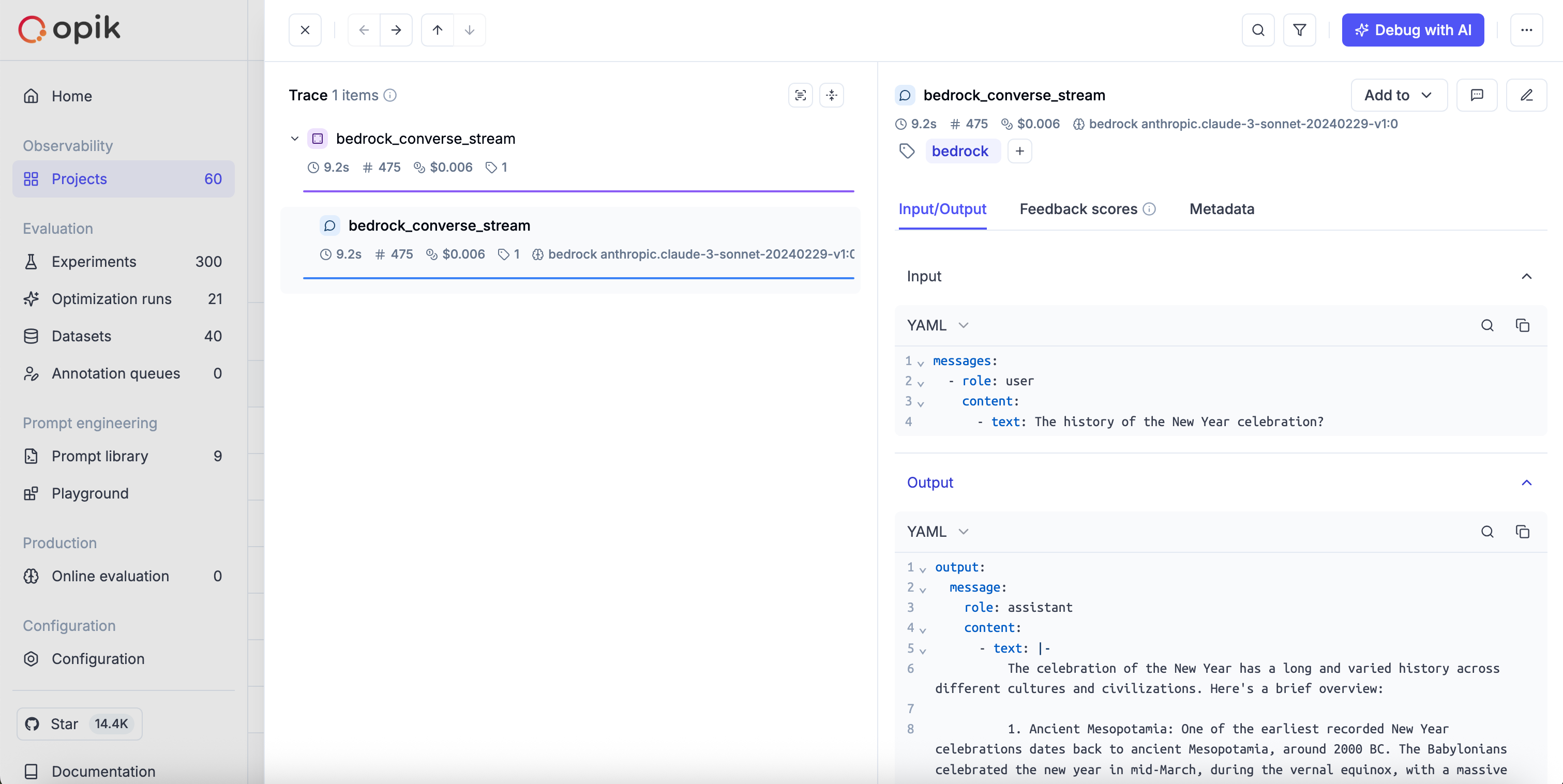
Section titled “Streaming API”Both Bedrock APIs support streaming responses, which is useful for real-time applications. Opik automatically tracks streaming calls for both APIs.
Converse Stream API
Section titled “Converse Stream API”The converse_stream method provides streaming with the unified interface:
import os
import boto3
from opik.integrations.bedrock import track_bedrock

# Set project name via environment variable
os.environ["OPIK_PROJECT_NAME"] = "bedrock-integration-demo"

# Initialize and track the Bedrock client
bedrock_client = boto3.client("bedrock-runtime", region_name="us-east-1")
bedrock_client = track_bedrock(bedrock_client)

def stream_conversation(
    bedrock_client,
    model_id,
    messages,
    system_prompts,
    inference_config,
):
    """
    Sends messages to a model and streams the response using Converse API.
    Args:
        bedrock_client: The Boto3 Bedrock runtime client.
        model_id (str): The model ID to use.
        messages (JSON) : The messages to send.
        system_prompts (JSON) : The system prompts to send.
        inference_config (JSON) : The inference configuration to use.

    Returns:
        Nothing.
    """
    response = bedrock_client.converse_stream(
        modelId=model_id,
        messages=messages,
        system=system_prompts,
        inferenceConfig=inference_config,
    )

    stream = response.get("stream")
    if stream:
        for event in stream:
            if "messageStart" in event:
                print(f"\nRole: {event['messageStart']['role']}")

            if "contentBlockDelta" in event:
                print(event["contentBlockDelta"]["delta"]["text"], end="")

            if "messageStop" in event:
                print(f"\nStop reason: {event['messageStop']['stopReason']}")

            if "metadata" in event:
                metadata = event["metadata"]
                if "usage" in metadata:
                    print("\nToken usage")
                    print(f"Input tokens: {metadata['usage']['inputTokens']}")
                    print(f"Output tokens: {metadata['usage']['outputTokens']}")
                    print(f"Total tokens: {metadata['usage']['totalTokens']}")

# Example usage
system_prompt = """You are an app that creates playlists for a radio station
  that plays rock and pop music. Only return song names and the artist."""

input_text = "Create a list of 3 pop songs."
messages = [{"role": "user", "content": [{"text": input_text}]}]
system_prompts = [{"text": system_prompt}]
inference_config = {"temperature": 0.5, "topP": 0.9}

stream_conversation(
    bedrock_client,
    "us.meta.llama3-2-3b-instruct-v1:0",
    messages,
    system_prompts,
    inference_config,
)
Invoke Model Stream API
Section titled “Invoke Model Stream API”The invoke_model_with_response_stream method supports streaming with model-specific formats:
import json
import os
import boto3
from opik.integrations.bedrock import track_bedrock

# Set project name via environment variable
os.environ["OPIK_PROJECT_NAME"] = "bedrock-integration-demo"

# Initialize and track the Bedrock client
bedrock_client = boto3.client("bedrock-runtime", region_name="us-east-1")
bedrock_client = track_bedrock(bedrock_client)

# Claude streaming with Anthropic message format
request_body = {
    "anthropic_version": "bedrock-2023-05-31",
    "max_tokens": 1000,
    "temperature": 0.7,
    "messages": [
        {
            "role": "user",
            "content": "Tell me about the benefits of LLM observability"
        }
    ]
}

response = bedrock_client.invoke_model_with_response_stream(
    modelId="us.anthropic.claude-3-5-sonnet-20241022-v2:0",
    body=json.dumps(request_body),
    contentType="application/json",
    accept="application/json"
)

# Simple streaming - just print the events
for event in response["body"]:
    chunk = json.loads(event["chunk"]["bytes"])
print(chunk)import json
import os
import boto3
from opik.integrations.bedrock import track_bedrock
# Set project name via environment variable
os.environ["OPIK_PROJECT_NAME"] = "bedrock-integration-demo"
# Initialize and track the Bedrock client
bedrock_client = boto3.client("bedrock-runtime", region_name="us-east-1")
bedrock_client = track_bedrock(bedrock_client)
# Nova streaming with Amazon's nested content format
request_body = {
"messages": [
{
"role": "user",
"content": [
{
"text": "Tell me about the benefits of LLM observability"
}
]
}
],
"inferenceConfig": {
"max_new_tokens": 1000,
"temperature": 0.7
}
}
response = bedrock_client.invoke_model_with_response_stream(
modelId="us.amazon.nova-pro-v1:0",
body=json.dumps(request_body),
contentType="application/json",
accept="application/json"
)
# Simple streaming - just print the events
for event in response["body"]:
chunk = json.loads(event["chunk"]["bytes"])
print(chunk)import json
import os
import boto3
from opik.integrations.bedrock import track_bedrock
# Set project name via environment variable
os.environ["OPIK_PROJECT_NAME"] = "bedrock-integration-demo"
# Initialize and track the Bedrock client
bedrock_client = boto3.client("bedrock-runtime", region_name="us-east-1")
bedrock_client = track_bedrock(bedrock_client)
# Llama streaming with prompt-based format and special tokens
request_body = {
"prompt": "<|begin_of_text|><|start_header_id|>user<|end_header_id|>\n\nTell me about the benefits of LLM observability<|eot_id|><|start_header_id|>assistant<|end_header_id|>\n\n",
"max_gen_len": 1000,
"temperature": 0.7,
"top_p": 0.9
}
response = bedrock_client.invoke_model_with_response_stream(
modelId="us.meta.llama3-1-8b-instruct-v1:0",
body=json.dumps(request_body),
contentType="application/json",
accept="application/json"
)
# Simple streaming - just print the events
for event in response["body"]:
chunk = json.loads(event["chunk"]["bytes"])
print(chunk)import json
import os
import boto3
from opik.integrations.bedrock import track_bedrock
# Set project name via environment variable
os.environ["OPIK_PROJECT_NAME"] = "bedrock-integration-demo"
# Initialize and track the Bedrock client
bedrock_client = boto3.client("bedrock-runtime", region_name="us-east-1")
bedrock_client = track_bedrock(bedrock_client)
# Mistral streaming with OpenAI-like message format
request_body = {
"messages": [
{
"role": "user",
"content": [
{
"type": "text",
"text": "Tell me about the benefits of LLM observability"
}
]
}
],
"max_tokens": 1000,
"temperature": 0.7,
"top_p": 0.9
}
response = bedrock_client.invoke_model_with_response_stream(
modelId="us.mistral.pixtral-large-2502-v1:0",
body=json.dumps(request_body),
contentType="application/json",
accept="application/json"
)
# Simple streaming - just print the events
for event in response["body"]:
chunk = json.loads(event["chunk"]["bytes"])
print(chunk)Advanced Usage
Section titled “Advanced Usage”Using with the @track decorator
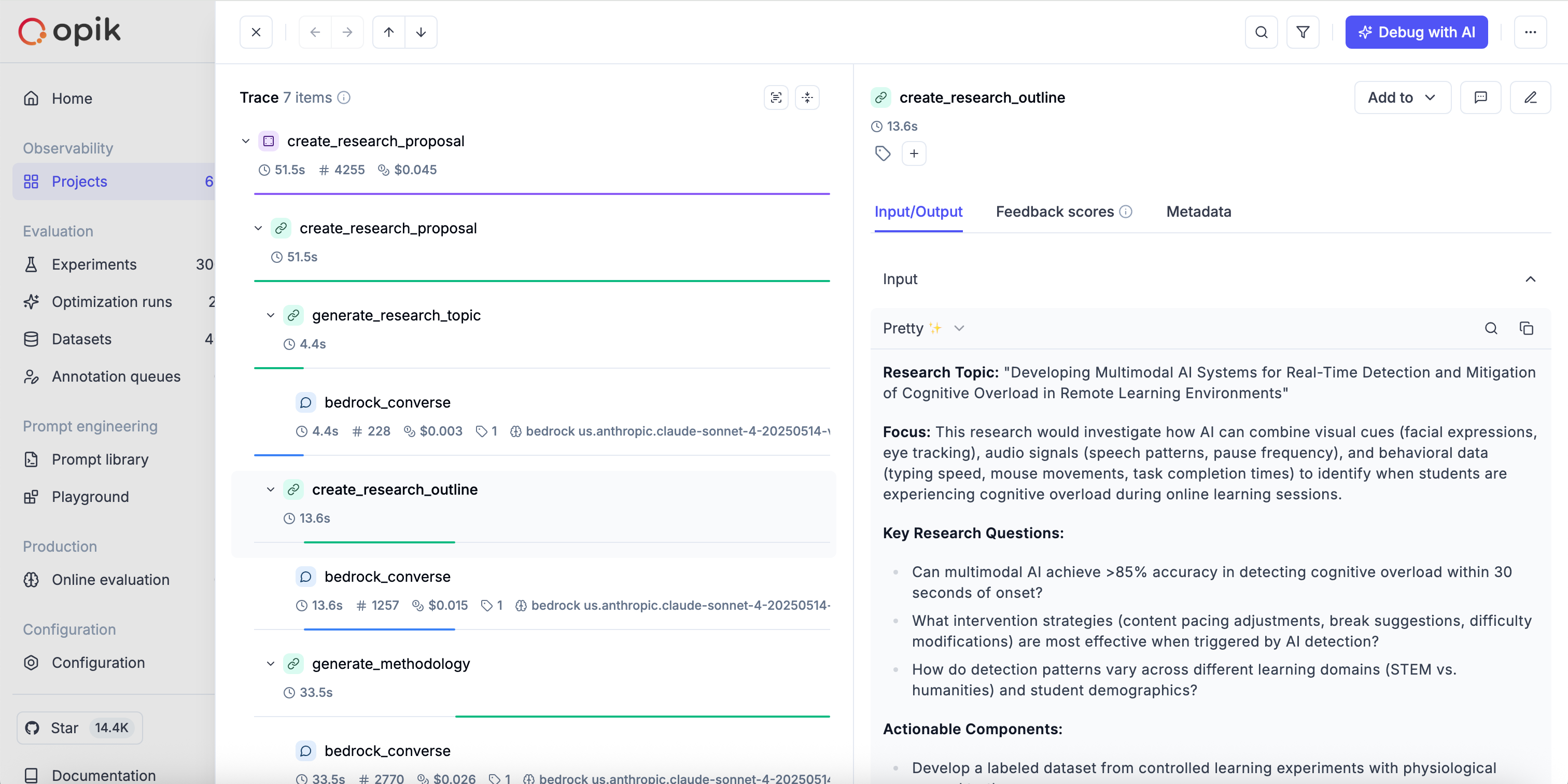
Section titled “Using with the @track decorator”If you have multiple steps in your LLM pipeline, you can use the @track decorator to log the traces for each step. If Bedrock is called within one of these steps, the LLM call will be associated with that corresponding step:
import boto3
from opik import track
from opik.integrations.bedrock import track_bedrock

# Initialize and track the Bedrock client
bedrock_client = boto3.client("bedrock-runtime", region_name="us-east-1")
bedrock_client = track_bedrock(bedrock_client, project_name="bedrock-integration-demo")

MODEL_ID = "us.anthropic.claude-3-5-sonnet-20241022-v2:0"

@track
def generate_story(prompt):
    res = bedrock_client.converse(
        modelId=MODEL_ID,
        messages=[{"role": "user", "content": [{"text": prompt}]}],
        inferenceConfig={"temperature": 0.7, "maxTokens": 1000}
    )
    return res["output"]["message"]["content"][0]["text"]

@track
def generate_topic():
    prompt = "Generate a topic for a story about Opik."
    res = bedrock_client.converse(
        modelId=MODEL_ID,
        messages=[{"role": "user", "content": [{"text": prompt}]}],
        inferenceConfig={"temperature": 0.7, "maxTokens": 500}
    )
    return res["output"]["message"]["content"][0]["text"]

@track
def generate_opik_story():
    topic = generate_topic()
    story = generate_story(topic)
    return story

# Execute the multi-step pipeline
generate_opik_story()
The trace can now be viewed in the UI with hierarchical spans showing the relationship between different steps:
Cost Tracking
Section titled “Cost Tracking”The track_bedrock wrapper automatically tracks token usage and cost for all supported AWS Bedrock models, regardless of whether you use the Converse API or the Invoke Model API.
Cost information is automatically captured and displayed in the Opik UI, including:
- Token usage details
- Cost per request based on Bedrock pricing
- Total trace cost