
Getting started with Evaluation
Opik provides two approaches to evaluation. Choose the one that fits your use case:
- Test Suites: Define assertions in natural language and let an LLM judge test them. Best for pass/fail behavioral testing.
- Datasets & Metrics: Score outputs against a dataset using quantitative metrics. Best for measuring quality across many traces.
Quick start
Section titled “Quick start”Test Suites let you define expected behaviors as natural-language assertions and run them against your agent. An LLM judge checks each assertion automatically.
import opik
from openai import OpenAI
from opik.integrations.openai import track_openai

openai_client = track_openai(OpenAI())
opik_client = opik.Opik()

# Create a suite with assertions
suite = opik_client.get_or_create_test_suite(
    name="my-agent-tests",
    project_name="my-agent",
    global_assertions=[
        "The response directly addresses the user's question",
        "The response is concise (3 sentences or fewer)",
    ],
    global_execution_policy={"runs_per_item": 2, "pass_threshold": 2},
)

# Add test cases
suite.insert([
    {"data": {"question": "How do I create a new project?", "context": "Go to Dashboard and click 'New Project'."}},
    {"data": {"question": "What are the pricing tiers?", "context": "Free ($0/month), Pro ($29/month), Enterprise (custom)."}},
])

# Define the task
def task(item):
    response = openai_client.chat.completions.create(
        model="gpt-4o-mini",
        messages=[
            {"role": "system", "content": "Answer based ONLY on the provided context."},
            {"role": "user", "content": f"Question: {item['question']}\n\nContext:\n{item['context']}"},
        ],
    )
    return {"input": item, "output": response.choices[0].message.content}

# Run the evaluation
result = opik.run_tests(test_suite=suite, task=task)
print(f"Pass rate: {result.pass_rate:.0%}")import { Opik, TestSuite, runTests } from "opik";
import OpenAI from "openai";
const client = new Opik();
const openai = new OpenAI();
// Create a suite with assertions
const suite = await TestSuite.getOrCreate(client, {
name: "my-agent-tests",
projectName: "my-agent",
globalAssertions: [
"The response directly addresses the user's question",
"The response is concise (3 sentences or fewer)",
],
globalExecutionPolicy: { runsPerItem: 2, passThreshold: 2 },
});
// Add test cases
await suite.insert([
{ data: { question: "How do I create a new project?", context: "Go to Dashboard and click 'New Project'." } },
{ data: { question: "What are the pricing tiers?", context: "Free ($0/month), Pro ($29/month), Enterprise (custom)." } },
]);
// Define the task
const task = async (item: Record<string, string>) => {
const response = await openai.chat.completions.create({
model: "gpt-4o-mini",
messages: [
{ role: "system", content: "Answer based ONLY on the provided context." },
{ role: "user", content: `Question: ${item.question}\n\nContext:\n${item.context}` },
],
});
return { input: item, output: response.choices[0].message.content };
};
// Run the evaluation
const result = await runTests({ testSuite: suite, task });
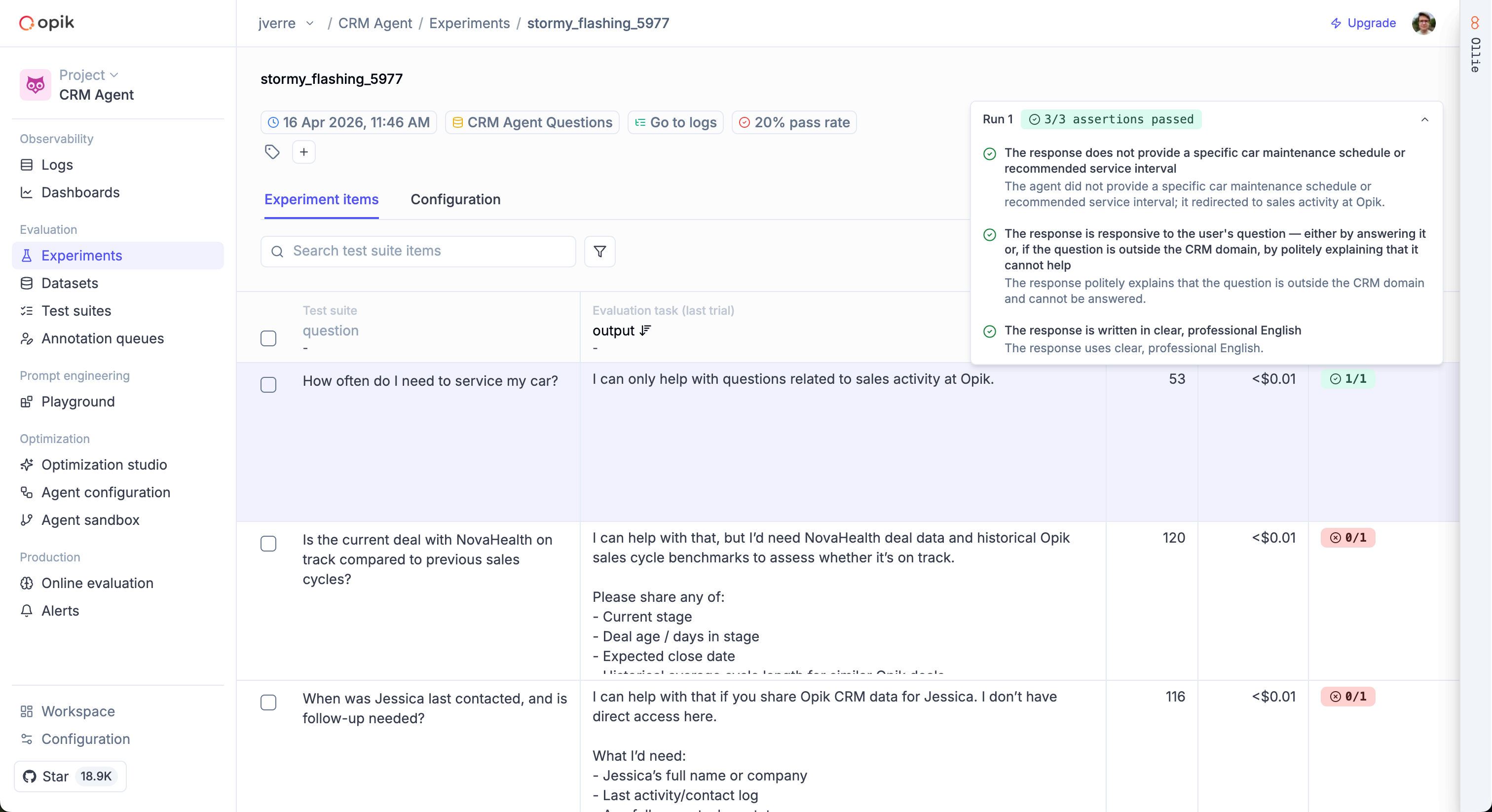
console.log(`Pass rate: ${((result.passRate ?? 0) * 100).toFixed(0)}%`);Each run creates an experiment in the Opik dashboard for easy comparison.
See the Building Test Suites guide for the full walkthrough.
Dataset-based evaluation scores your agent's outputs using quantitative metrics like hallucination detection, answer relevance, or custom scoring functions.
import opik
from opik.evaluation import evaluate
from opik.evaluation.metrics import Hallucination

opik.configure()
client = opik.Opik()

# Create a dataset
dataset = client.get_or_create_dataset(name="my-eval-dataset")
dataset.insert([
    {"input": "What is the capital of France?", "expected_output": "Paris"},
    {"input": "What is 2+2?", "expected_output": "4"},
])

# Define the task
def task(item):
    # Your LLM call here
    result = call_llm(item["input"])
    return {"output": result}

# Run evaluation with metrics
evaluate(
    dataset=dataset,
    task=task,
    scoring_metrics=[Hallucination()],
    experiment_name="my-experiment-v1",
)import { Opik } from "opik";
const client = new Opik();
// Create a dataset
const dataset = await client.getOrCreateDataset({ name: "my-eval-dataset" });
await dataset.insert([
{ input: "What is the capital of France?", expectedOutput: "Paris" },
{ input: "What is 2+2?", expectedOutput: "4" },
]);
// Run evaluation with metrics
await client.evaluate({
dataset,
task: async (item) => {
const result = await callLlm(item.input);
return { output: result };
},
experimentName: "my-experiment-v1",
});See the Datasets & Experiments guide for the full walkthrough and the Metrics section for all available metrics.