Observability for n8n with Opik
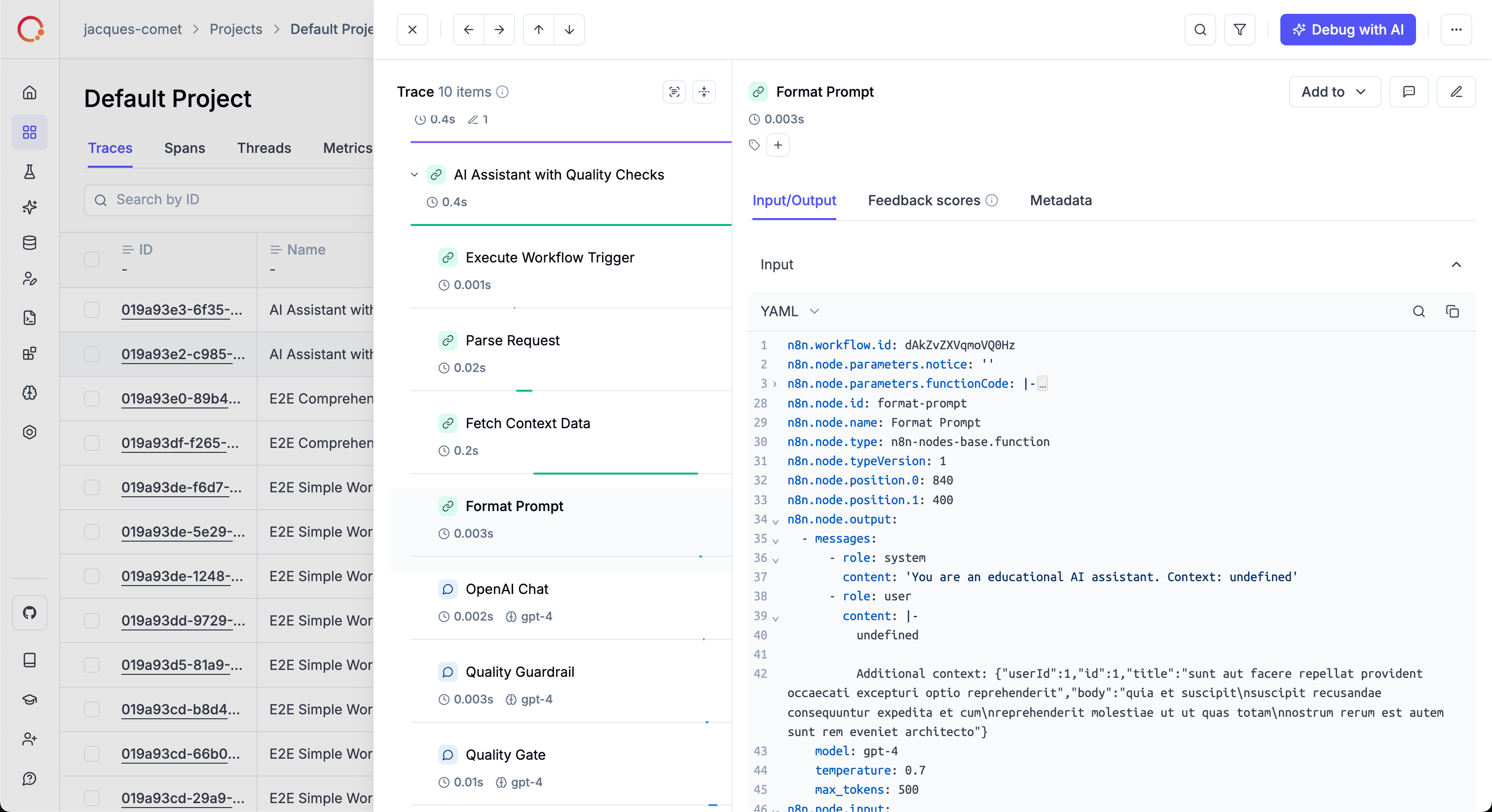
n8n is a powerful workflow automation platform that allows you to connect various services and automate tasks through a visual interface. With the n8n-observability package, you can automatically trace workflow executions and node operations using OpenTelemetry.
Features
Section titled “Features”- 🔍 Automatic tracing of workflow executions and individual node operations
- 📊 Standard OpenTelemetry instrumentation using the official Node.js SDK
- 🎯 Zero-code setup via n8n's hook system
- 🔌 OTLP compatible - works with Opik's OpenTelemetry endpoint
- ⚙️ Configurable I/O capture, node filtering, and more
Account Setup
Section titled “Account Setup”Comet provides a hosted version of the Opik platform. Simply create an account and grab your API Key.
You can also run the Opik platform locally, see the installation guide for more information.
Quick Start with Docker
Section titled “Quick Start with Docker”The fastest way to get started is with Docker Compose:
# Clone and navigate to the example
git clone https://github.com/comet-ml/n8n-observability.git
cd n8n-observability/examples/docker-compose

# Set your Opik API key (get one free at https://www.comet.com/signup)
export OPIK_API_KEY=your_api_key_here

# Build and run
docker-compose up --build
Open http://localhost:5678, create a workflow, and see traces in your Opik dashboard!
Setup Options
Section titled “Setup Options”Docker (Recommended)
Section titled “Docker (Recommended)”Create a custom Dockerfile that installs the n8n-observability package globally:
FROM n8nio/n8n:latest

USER root
RUN npm install -g n8n-observability

ENV EXTERNAL_HOOK_FILES=/usr/local/lib/node_modules/n8n-observability/dist/hooks.cjs

USER node
Then configure your docker-compose.yml with OTLP settings:
services:
  n8n:
    build: .
    environment:
      OTEL_EXPORTER_OTLP_ENDPOINT: "https://www.comet.com/opik/api/v1/private/otel"
      OTEL_EXPORTER_OTLP_HEADERS: "Authorization=${OPIK_API_KEY},Comet-Workspace=default"
      N8N_OTEL_SERVICE_NAME: "my-n8n"
    volumes:
      - n8n_data:/home/node/.n8n
    ports:
      - "5678:5678"

volumes:
n8n_data:services:
n8n:
build: .
environment:
OTEL_EXPORTER_OTLP_ENDPOINT: "https://<comet-deployment-url>/opik/api/v1/private/otel"
OTEL_EXPORTER_OTLP_HEADERS: "Authorization=${OPIK_API_KEY},Comet-Workspace=default"
N8N_OTEL_SERVICE_NAME: "my-n8n"
volumes:
- n8n_data:/home/node/.n8n
ports:
- "5678:5678"
volumes:
n8n_data:services:
n8n:
build: .
environment:
OTEL_EXPORTER_OTLP_ENDPOINT: "http://localhost:5173/api/v1/private/otel"
OTEL_EXPORTER_OTLP_HEADERS: "projectName=my-n8n-project"
N8N_OTEL_SERVICE_NAME: "my-n8n"
volumes:
- n8n_data:/home/node/.n8n
ports:
- "5678:5678"
volumes:
n8n_data:Bare Metal / npm
Section titled “Bare Metal / npm”If you're running n8n directly on your machine:
# Install globally
npm install -g n8n-observability
Then set the required environment variables:
export OTEL_EXPORTER_OTLP_ENDPOINT=https://www.comet.com/opik/api/v1/private/otel
export OTEL_EXPORTER_OTLP_HEADERS='Authorization=<your-api-key>,Comet-Workspace=default'
export N8N_OTEL_SERVICE_NAME=my-n8n
export EXTERNAL_HOOK_FILES=$(npm root -g)/n8n-observability/dist/hooks.cjs

# Start n8n
n8n startexport OTEL_EXPORTER_OTLP_ENDPOINT=https://<comet-deployment-url>/opik/api/v1/private/otel
export OTEL_EXPORTER_OTLP_HEADERS='Authorization=<your-api-key>,Comet-Workspace=default'
export N8N_OTEL_SERVICE_NAME=my-n8n
export EXTERNAL_HOOK_FILES=$(npm root -g)/n8n-observability/dist/hooks.cjs
# Start n8n
n8n startexport OTEL_EXPORTER_OTLP_ENDPOINT=http://localhost:5173/api/v1/private/otel
export OTEL_EXPORTER_OTLP_HEADERS='projectName=my-n8n-project'
export N8N_OTEL_SERVICE_NAME=my-n8n
export EXTERNAL_HOOK_FILES=$(npm root -g)/n8n-observability/dist/hooks.cjs
# Start n8n
n8n startConfiguration
Section titled “Configuration”The following environment variables can be used to configure the integration:
| Variable | Purpose | Default |
|---|---|---|
OTEL_EXPORTER_OTLP_ENDPOINT |
OTLP exporter endpoint | — |
OTEL_EXPORTER_OTLP_HEADERS |
OTLP headers (e.g., auth tokens) | — |
N8N_OTEL_SERVICE_NAME |
Service name for telemetry | n8n |
N8N_OTEL_NODE_INCLUDE |
Only trace listed nodes (comma-separated) | — |
N8N_OTEL_NODE_EXCLUDE |
Exclude listed nodes (comma-separated) | — |
N8N_OTEL_CAPTURE_INPUT |
Capture node input data | true |
N8N_OTEL_CAPTURE_OUTPUT |
Capture node output data | true |
N8N_OTEL_AUTO_INSTRUMENT |
Enable HTTP/Express instrumentation | false |
N8N_OTEL_METRICS |
Enable metrics collection | false |
N8N_OTEL_DEBUG |
Enable debug logging | false |
EXTERNAL_HOOK_FILES |
Path to hooks.cjs (set automatically) | — |
Node Filtering
Section titled “Node Filtering”You can filter which nodes are traced using environment variables:
# Only trace specific nodes
export N8N_OTEL_NODE_INCLUDE="OpenAI,HTTP Request"

# Exclude noisy nodes
export N8N_OTEL_NODE_EXCLUDE="Wait,Set"

# Disable I/O capture for privacy
export N8N_OTEL_CAPTURE_INPUT=false
export N8N_OTEL_CAPTURE_OUTPUT=false
What Gets Tracked
Section titled “What Gets Tracked”Workflow Spans
Section titled “Workflow Spans”Each workflow execution creates a span with the following attributes:
n8n.workflow.id- Workflow IDn8n.workflow.name- Workflow namen8n.span.type-"workflow"
Node Spans
Section titled “Node Spans”Each node operation creates a span with:
n8n.node.type- Node type (e.g.,n8n-nodes-base.httpRequest)n8n.node.name- Node namen8n.span.type-"llm","prompt","evaluation", or undefinedn8n.node.input- JSON input (if capture enabled)n8n.node.output- JSON output (if capture enabled)gen_ai.system- AI provider (e.g.,openai,anthropic)gen_ai.request.model- Model name (e.g.,gpt-4)
Verify Installation
Section titled “Verify Installation”Check that the package is installed correctly:
node -e "console.log(require.resolve('n8n-observability/hooks'))"On startup, you should see logs similar to:
[otel-setup] OpenTelemetry initialized: my-n8n (OTLP export enabled, n8n spans only)
[n8n-observability] observability ready and patches applied
Further Improvements
Section titled “Further Improvements”If you would like to see us improve this integration, please open a new feature request on GitHub.
For issues specific to the n8n-observability package, visit the n8n-observability repository.