
Evolutionary Optimizer: Genetic Algorithms
The EvolutionaryOptimizer uses genetic algorithms to refine and discover effective prompts. It
iteratively evolves a population of prompts, applying selection, crossover, and mutation operations
to find prompts that maximize a given evaluation metric. This optimizer can also perform
multi-objective optimization (e.g., maximizing score while minimizing prompt length) and leverage
LLMs for more sophisticated genetic operations.
How It Works
Section titled “How It Works”The EvolutionaryOptimizer is built upon the DEAP library for
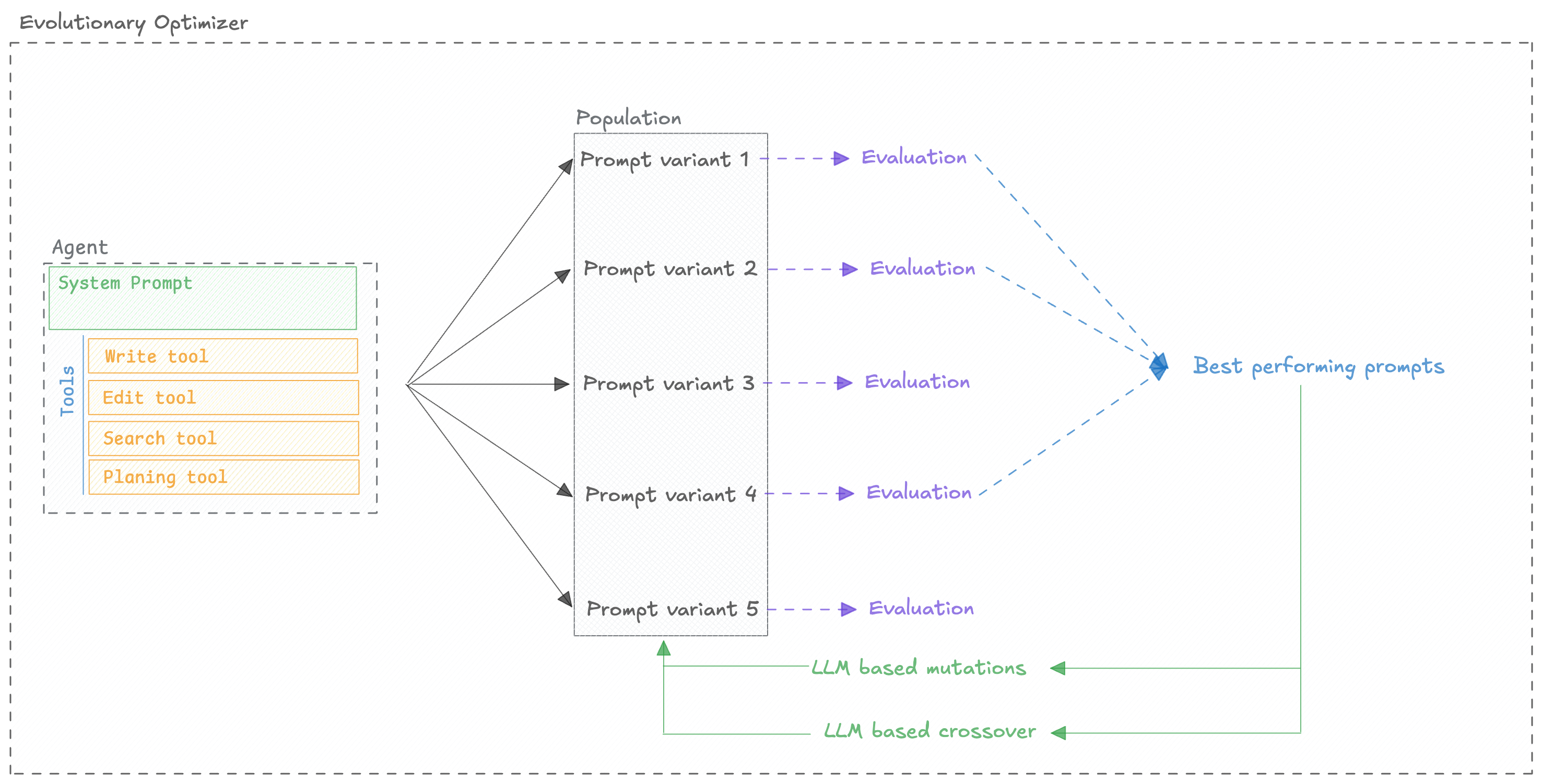
evolutionary computation. The core concept behind the optimizer is that we evolve a population of
prompts over multiple generations to find the best one.
We utilize different techniques to evolve the population of prompts:
- Selection: We select the best prompts from the population to be the parents of the next generation.
- Crossover: We crossover the parents to create the children of the next generation.
- Mutation: We mutate the children to create the new population of prompts.
We repeat this process for a number of generations until we find the best prompt.
Quickstart
Section titled “Quickstart”You can use the EvolutionaryOptimizer to optimize a prompt:
from opik_optimizer import EvolutionaryOptimizer
from opik.evaluation.metrics import LevenshteinRatio # or any other suitable metric
from opik_optimizer import datasets, ChatPrompt

# 1. Define your evaluation dataset
dataset = datasets.tiny_test() # Replace with your actual dataset

# 2. Configure the evaluation metric
def levenshtein_ratio(dataset_item, llm_output):
    return LevenshteinRatio().score(reference=dataset_item["label"], output=llm_output)

# 3. Define your base prompt and task configuration
initial_prompt = ChatPrompt(
    messages=[
        {"role": "system", "content": "You are a helpful assistant."},
        {"role": "user", "content": "{text}"}
    ]
)

# 4. Initialize the EvolutionaryOptimizer
optimizer = EvolutionaryOptimizer(
    model="openai/gpt-4o-mini",
    model_parameters={"temperature": 0.4},
    population_size=20,
    num_generations=10,
)

# 5. Run the optimization
optimization_result = optimizer.optimize_prompt(
    prompt=initial_prompt,
    dataset=dataset,
    metric=levenshtein_ratio,
    n_samples=5
)

# 6. View the results
optimization_result.display()
Configuration Options
Section titled “Configuration Options”Optimizer parameters
Section titled “Optimizer parameters”The optimizer has the following parameters:
-
model(str, default: openai/gpt-5-nano) — -
model_parameters(dict[str, typing.Any] | None) — -
population_size(int, default: 30) — -
num_generations(int, default: 15) — -
mutation_rate(float, default: 0.2) — -
crossover_rate(float, default: 0.8) — -
tournament_size(int, default: 4) — -
elitism_size(int, default: 3) — -
adaptive_mutation(bool, default: True) — -
enable_moo(bool, default: True) — -
enable_llm_crossover(bool, default: True) — -
output_style_guidance(str | None) — -
infer_output_style(bool, default: False) — -
n_threads(int, default: 12) — -
verbose(int, default: 1) — -
seed(int, default: 42) —
optimize_prompt parameters
Section titled “optimize_prompt parameters”The optimize_prompt method has the following parameters:
-
prompt(ChatPrompt) — The prompt to optimize -
dataset(Dataset) — The dataset to use for evaluation -
metric(Callable) — Metric function to optimize with, should have the argumentsdataset_itemandllm_output -
experiment_config(dict | None) — Optional experiment configuration -
n_samples(int | float | str | None) — Number of dataset items to use per evaluation. Use counts (e.g.,50), fractions (e.g.,0.1), percentages (e.g., "10%"), or "all"/"full"/None for the full dataset. -
n_samples_minibatch(int | None) — Optional number of samples for inner-loop minibatches (defaults to n_samples). -
n_samples_strategy(str | None) — Sampling strategy for subsampling (default: "random_sorted"). -
auto_continue(bool, default: False) — Whether to automatically continue optimization -
agent_class(type[opik_optimizer.optimizable_agent.OptimizableAgent] | None) — Optional agent class to use -
project_name(str, default: Optimization) — Opik project name for logging traces (default: "Optimization") -
max_trials(int, default: 10) — -
mcp_config(opik_optimizer.mcp_utils.mcp_workflow.MCPExecutionConfig | None) — MCP tool calling configuration (default: None) -
args(Any) — -
kwargs(Any) —
Model Support
Section titled “Model Support”There are two models to consider when using the EvolutionaryOptimizer:
EvolutionaryOptimizer.model: The model used for the evolution of the population of prompts.ChatPrompt.model: The model used to evaluate the prompt.
The model parameter accepts any LiteLLM-supported model string (e.g., "gpt-4o", "azure/gpt-4",
"anthropic/claude-3-opus", "gemini/gemini-1.5-pro"). You can also pass in extra model parameters
using the model_parameters parameter:
optimizer = EvolutionaryOptimizer(
    model="anthropic/claude-3-opus-20240229",
    model_parameters={
        "temperature": 0.7,
        "max_tokens": 4096
    }
)
Next Steps
Section titled “Next Steps”- Explore specific Optimizers for algorithm details.
- Refer to the FAQ for common questions and troubleshooting.
- Refer to the API Reference for detailed configuration options.