
Evaluate your agent
Evaluating your LLM application allows you to have confidence in the performance of your LLM application. In this guide, we will walk through the process of evaluating complex applications like LLM chains or agents.
The evaluation is done in five steps:
- Add tracing to your LLM application
- Define the evaluation task
- Choose the
Datasetthat you would like to evaluate your application on - Choose the metrics that you would like to evaluate your application with
- Create and run the evaluation experiment
Running an offline evaluation
Section titled “Running an offline evaluation”1. (Optional) Add tracking to your LLM application
Section titled “1. (Optional) Add tracking to your LLM application”While not required, we recommend adding tracking to your LLM application. This allows you to have
full visibility into each evaluation run. In the example below we will use a combination of the
track decorator and the track_openai function to trace the LLM application.
from opik import track
from opik.integrations.openai import track_openai
import openai

openai_client = track_openai(openai.OpenAI())

# This method is the LLM application that you want to evaluate
# Typically this is not updated when creating evaluations
@track
def your_llm_application(input: str) -> str:
    response = openai_client.chat.completions.create(
        model="gpt-3.5-turbo",
        messages=[{"role": "user", "content": input}],
    )

return response.choices[0].message.content2. Define the evaluation task
Section titled “2. Define the evaluation task”Once you have added instrumentation to your LLM application, we can define the evaluation task. The evaluation task takes in as an input a dataset item and needs to return a dictionary with keys that match the parameters expected by the metrics you are using. In this example we can define the evaluation task as follows:
import { EvaluationTask } from "opik";
import { OpenAI } from "openai";

// Define dataset item type
type DatasetItem = {
input: string;
expected: string;
};

const llmTask: EvaluationTask<DatasetItem> = async (datasetItem) => {
    const { input } = datasetItem;

    const openai = new OpenAI();
    const response = await openai.chat.completions.create({
        model: "gpt-4o",
        messages: [
            { role: "system", content: "You are a coding assistant" },
            { role: "user", content: input }
        ],
    });

    return { output: response.choices[0].message.content };

};
def evaluation_task(x):
    return {
        "output": your_llm_application(x['user_question'])
}3. Choose the evaluation Dataset
Section titled “3. Choose the evaluation Dataset”In order to create an evaluation experiment, you will need to have a Dataset that includes all your test cases.
If you have already created a Dataset, you can use the get or create dataset methods to fetch it.
import { Opik } from "opik";

const client = new Opik();
const dataset = await client.getOrCreateDataset<DatasetItem>("Example dataset", "Evaluation dataset", "my-project");

// Opik deduplicates items that are inserted into a dataset so we can insert them
// for multiple times
await dataset.insert([
    {
        input: "Hello, world!",
        expected: "Hello, world!"
    },
    {
        input: "What is the capital of France?",
        expected: "Paris"
    },
]);from opik import Opik
client = Opik()
dataset = client.get_or_create_dataset(name="Example dataset", project_name="my-project")
# Opik deduplicates items that are inserted into a dataset so we can insert them
# for multiple times
dataset.insert([
{
"input": "Hello, world!",
"expected_output": "Hello, world!"
},
{
"input": "What is the capital of France?",
"expected_output": "Paris"
},
])4. Choose evaluation metrics
Section titled “4. Choose evaluation metrics”Opik provides a set of built-in evaluation metrics that you can choose from. These are broken down into two main categories:
- Heuristic metrics: These metrics that are deterministic in nature, for example
equalsorcontains - LLM-as-a-judge: These metrics use an LLM to judge the quality of the output; typically these are used for detecting
hallucinationsorcontext relevance
In the same evaluation experiment, you can use multiple metrics to evaluate your application:
import { ExactMatch } from "opik";

const exact_match_metric = new ExactMatch();
from opik.evaluation.metrics import Hallucination

hallucination_metric = Hallucination()5. Run the evaluation
Section titled “5. Run the evaluation”Now that we have the task we want to evaluate, the dataset to evaluate on, and the metrics we want to evaluate with, we can run the evaluation:
import { EvaluationTask, Opik, ExactMatch, evaluate } from "opik";
import { OpenAI } from "openai";

// Define dataset item type
type DatasetItem = {
    input: string;
    expected: string;
};

// Define the evaluation task
const llmTask: EvaluationTask<DatasetItem> = async (datasetItem) => {
    const { input } = datasetItem;

    const openai = new OpenAI();
    const response = await openai.chat.completions.create({
        model: "gpt-4o",
        messages: [
            { role: "system", content: "You are a coding assistant" },
            { role: "user", content: input }
        ],
    });

    return { output: response.choices[0].message.content };
};

// Get or create the dataset - items are automatically deduplicated
const client = new Opik();
const dataset = await client.getOrCreateDataset<DatasetItem>("Example dataset", "Evaluation dataset", "my-project");
await dataset.insert([
    {
        input: "Hello, world!",
        expected: "Hello, world!"
    },
    {
        input: "What is the capital of France?",
        expected: "Paris"
    },
]);

// Define the metric
const exact_match_metric = new ExactMatch();

// Run the evaluation
const result = await evaluate({
    dataset,
    task: llmTask,
    scoringMetrics: [exact_match_metric],
    experimentName: "Example Evaluation",
    projectName: "my-project",
});
console.log(`Experiment ID: ${result.experimentId}`);
console.log(`Experiment Name: ${result.experimentName}`);
console.log(`Total test cases: ${result.testResults.length}`);import opik
from opik import Opik, track
from opik.evaluation import evaluate
from opik.evaluation.metrics import Equals, Hallucination
from opik.integrations.openai import track_openai
import openai
opik.configure(project_name="my-project")
# Define the task to evaluate
openai_client = track_openai(openai.OpenAI())
MODEL = "gpt-3.5-turbo"
@track
def your_llm_application(input: str) -> str:
response = openai_client.chat.completions.create(
model=MODEL,
messages=[{"role": "user", "content": input}],
)
return response.choices[0].message.content
# Define the evaluation task
def evaluation_task(x):
return {
"output": your_llm_application(x['input'])
}
# Create a simple dataset
client = Opik()
dataset = client.get_or_create_dataset(name="Example dataset", project_name="my-project")
dataset.insert([
{"input": "What is the capital of France?"},
{"input": "What is the capital of Germany?"},
])
# Define the metrics
hallucination_metric = Hallucination()
evaluation = evaluate(
dataset=dataset,
task=evaluation_task,
scoring_metrics=[hallucination_metric],
project_name="my-project",
experiment_config={
"model": MODEL
}
)6. Analyze the evaluation results
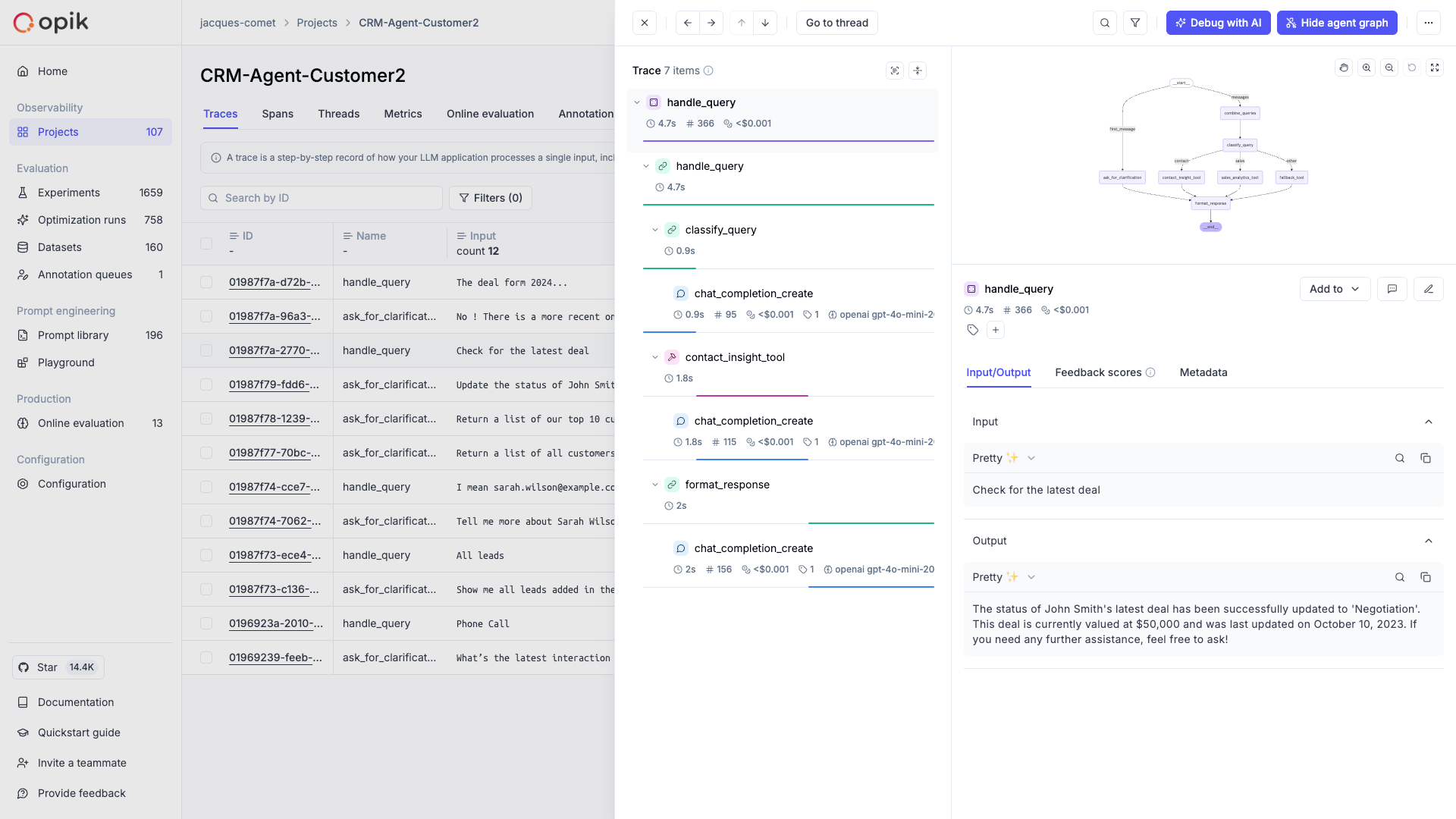
Section titled “6. Analyze the evaluation results”Once the evaluation is complete, you will get a link to the Opik UI where you can analyze the evaluation results. In addition to being able to deep dive into each test case, you will also be able to compare multiple experiments side by side.
Advanced usage
Section titled “Advanced usage”Missing arguments for scoring methods
Section titled “Missing arguments for scoring methods”When you face the opik.exceptions.ScoreMethodMissingArguments exception, it means that the dataset
item and task output dictionaries do not contain all the arguments expected by the scoring method.
The way the evaluate function works is by merging the dataset item and task output dictionaries and
then passing the result to the scoring method. For example, if the dataset item contains the keys
user_question and context while the evaluation task returns a dictionary with the key output,
the scoring method will be called as scoring_method.score(user_question='...', context= '...', output= '...').
This can be an issue if the scoring method expects a different set of arguments.
You can solve this by either updating the dataset item or evaluation task to return the missing
arguments or by using the scoring_key_mapping parameter of the evaluate function. In the example
above, if the scoring method expects input as an argument, you can map the user_question key to
the input key as follows:
evaluation = evaluate({
    dataset,
    task: evaluation_task,
    scoringMetrics: [hallucination_metric],
    scoringKeyMapping: {"input": "user_question"},
})evaluation = evaluate(
dataset=dataset,
task=evaluation_task,
scoring_metrics=[hallucination_metric],
scoring_key_mapping={"input": "user_question"},
)Linking prompts to experiments
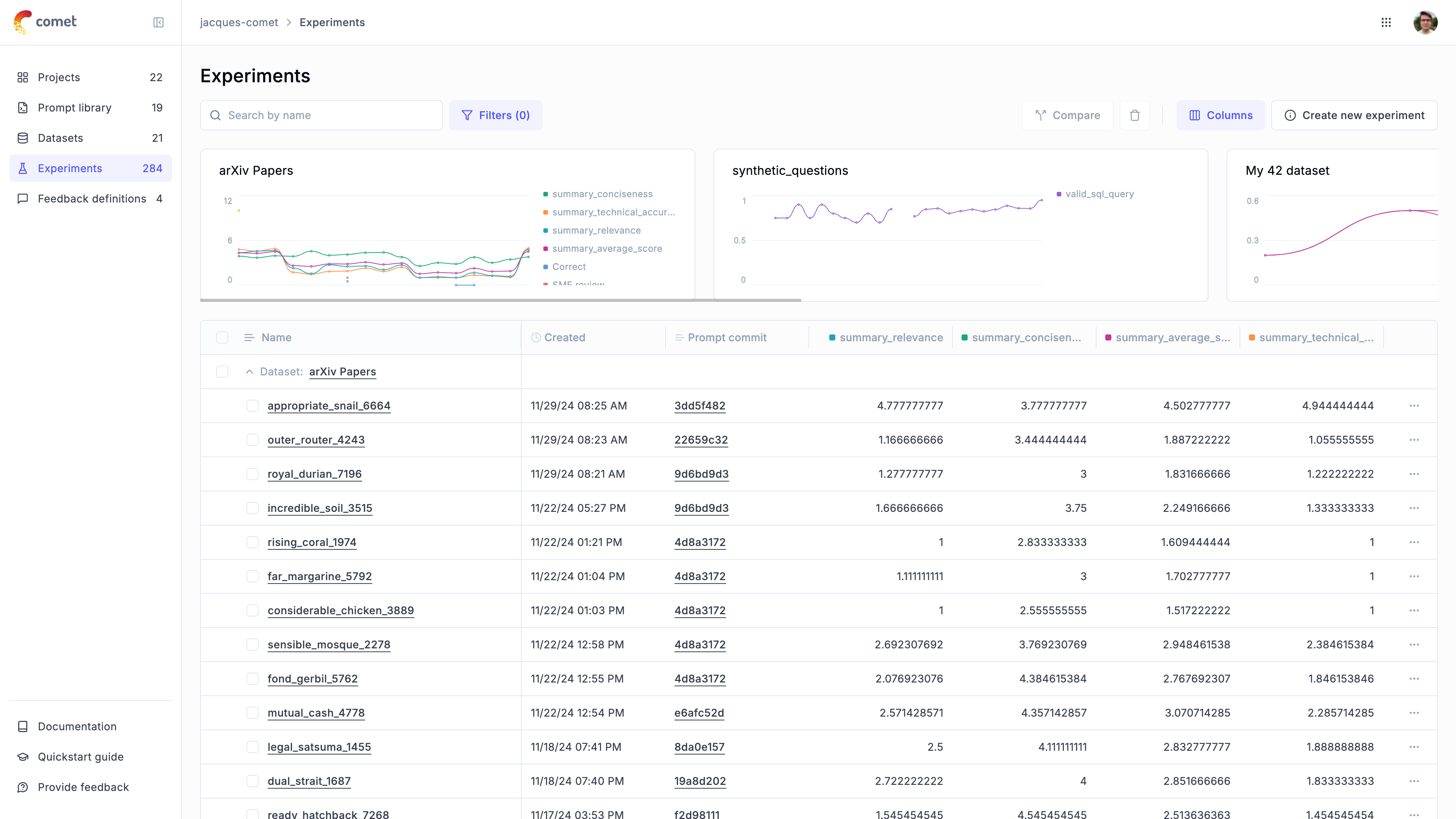
Section titled “Linking prompts to experiments”The Opik prompt library can be used to version your prompt templates.
When creating an Experiment, you can link the Experiment to a specific prompt version:
import { Opik, evaluate, evaluatePrompt } from 'opik';
import { Hallucination } from 'opik';

const client = new Opik();

// Create a prompt
const prompt = await client.createPrompt({
    name: "My prompt",
    prompt: "Translate to French: {{input}}",
    projectName: "my-project",
});

// Link prompt to evaluation experiment
await evaluatePrompt({
    dataset: myDataset,
    messages: [
        { role: "user", content: "Translate to French: {{input}}" },
    ],
    model: "gpt-4o",
    scoringMetrics: [new Hallucination()],
    prompts: [prompt],
    projectName: "my-project",
});import opik
# Create a prompt
prompt = opik.Prompt(
name="My prompt",
prompt="...",
project_name="my-project",
)
# Run the evaluation
evaluation = evaluate(
dataset=dataset,
task=evaluation_task,
scoring_metrics=[hallucination_metric],
prompts=[prompt],
project_name="my-project",
)The experiment will now be linked to the prompt allowing you to view all experiments that use a specific prompt:
Logging traces to a specific project
Section titled “Logging traces to a specific project”You can use the project_name parameter of the evaluate function to log evaluation traces to a specific project:
const evaluation = await evaluate({
    dataset,
    task: evaluation_task,
    scoringMetrics: [hallucination_metric],
    projectName: "hallucination-detection",
})evaluation = evaluate(
dataset=dataset,
task=evaluation_task,
scoring_metrics=[hallucination_metric],
project_name="hallucination-detection",
)Evaluating a subset of the dataset
Section titled “Evaluating a subset of the dataset”You can use the nb_samples parameter to specify the number of samples to use for the evaluation. This is useful if you only want to evaluate a subset of the dataset.
const evaluation = await evaluate({
    dataset,
    task: evaluation_task,
    scoringMetrics: [hallucination_metric],
    nbSamples: 10,
})evaluation = evaluate(
experiment_name="My experiment",
dataset=dataset,
task=evaluation_task,
scoring_metrics=[hallucination_metric],
nb_samples=10,
)Evaluating a filtered subset of the dataset
Section titled “Evaluating a filtered subset of the dataset”You can evaluate only a subset of your dataset items by using the dataset_filter_string parameter. This is useful when you want to run experiments on specific categories of data or test particular scenarios:
from opik.evaluation import evaluate

# Evaluate only items with specific tags
evaluation = evaluate(
    experiment_name="Production test cases",
    dataset=dataset,
    task=evaluation_task,
    scoring_metrics=[hallucination_metric],
    dataset_filter_string='tags contains "production"',
)

# Evaluate items matching multiple conditions
evaluation = evaluate(
    experiment_name="Hard finance questions",
    dataset=dataset,
    task=evaluation_task,
    scoring_metrics=[hallucination_metric],
    dataset_filter_string='data.category = "finance" AND data.difficulty = "hard"',
)

# Filter by date range
evaluation = evaluate(
    experiment_name="Recent test cases",
    dataset=dataset,
    task=evaluation_task,
    scoring_metrics=[hallucination_metric],
    dataset_filter_string='created_at >= "2024-06-01T00:00:00Z"',
)
The filter uses Opik Query Language (OQL) syntax. For more details on filter syntax and supported columns, see Filtering syntax.
Sampling the dataset for evaluation
Section titled “Sampling the dataset for evaluation”You can use the dataset_sampler parameter to specify the instance of dataset sampler to use for sampling the dataset.
This is useful if you want to sample the dataset differently than the default sampling strategy (accept all items).
For example, you can use the RandomDatasetSampler to sample the dataset randomly:
from opik.evaluation import samplers

evaluation = evaluate(
    experiment_name="My experiment",
    dataset=dataset,
    task=evaluation_task,
    scoring_metrics=[hallucination_metric],
    dataset_sampler=samplers.RandomDatasetSampler(max_samples=10),
)
In the example above, the evaluation will sample 10 random items from the dataset.
Also, you can implement your own dataset sampler by extending the BaseDatasetSampler and overriding the sample method.
import re
from typing import List

from opik.api_objects.dataset import dataset_item
from opik.evaluation import samplers

class MyDatasetSampler(samplers.BaseDatasetSampler):

    def __init__(self, filter_string: str, field_name: str) -> None:
        self.filter_regex = re.compile(filter_string)
        self.field_name = field_name

    def sample(self, dataset: List[dataset_item.DatasetItem]) -> List[dataset_item.DatasetItem]:
        # Sample items from the dataset that match the filter string in the 'field_name' field
        return [item for item in filter(lambda x: self.filter_regex.search(x[self.field_name]), dataset)]

# Example usage
evaluation = evaluate(
    experiment_name="My experiment",
    dataset=dataset,
    task=evaluation_task,
    scoring_metrics=[hallucination_metric],
    dataset_sampler=MyDatasetSampler(filter_string="\\.*SUCCESS\\.*", field_name="output"),
)
Implementing your own dataset sampler is useful if you want to implement a custom sampling strategy. For instance, you can implement a dataset sampler that samples the dataset using some filtering criteria as in the example above.
Analyzing the evaluation results
Section titled “Analyzing the evaluation results”The evaluate function returns an EvaluationResult object that contains the evaluation results.
You can create aggregated statistics for each metric by calling its aggregate_evaluation_scores method:
    evaluation = evaluate(
        experiment_name="My experiment",
        dataset=dataset,
        task=evaluation_task,
        scoring_metrics=[hallucination_metric],
    )

    # Retrieve and print the aggregated scores statistics (mean, min, max, std) per metric
    scores = evaluation.aggregate_evaluation_scores()
    for metric_name, statistics in scores.aggregated_scores.items():
        print(f"{metric_name}: {statistics}")

    ```
Aggregated statistics can help analyze evaluation results and are useful for comparing the performance of different models or different versions of the same model, for example.
Computing experiment-level metrics
Section titled “Computing experiment-level metrics”In addition to per-item metrics, you can compute experiment-level aggregate metrics that are calculated across all test results. These experiment scores are displayed in the Opik UI alongside feedback scores and can be used for sorting and filtering experiments.
Experiment scores are computed after all test results are collected. You define experiment score functions that take a list of TestResult objects and return a list of ScoreResult objects representing aggregate metrics.
from typing import List
from opik.evaluation import evaluate, test_result
from opik.evaluation.metrics import Hallucination, score_result

# Define an experiment score function
def compute_hallucination_max(
    test_results: List[test_result.TestResult],
) -> List[score_result.ScoreResult]:
    """Compute the maximum hallucination score across all test results."""
    hallucination_scores = [
        result.score_results[0].value
        for result in test_results
        if result.score_results and len(result.score_results) > 0
    ]

    if not hallucination_scores:
        return []

    return [
        score_result.ScoreResult(
            name="hallucination_metric (max)",
            value=max(hallucination_scores),
            reason=f"Maximum hallucination score across {len(hallucination_scores)} test cases"
        )
    ]

# Run evaluation with experiment scores
evaluation = evaluate(
    dataset=dataset,
    task=evaluation_task,
    scoring_metrics=[Hallucination()],
    experiment_scoring_functions=[compute_hallucination_max],
    experiment_name="My experiment"
)

# Access experiment scores from the result
print(f"Experiment scores: {evaluation.experiment_scores}")You can define multiple experiment score functions to compute different aggregate metrics:
from typing import List
from opik.evaluation import evaluate, test_result
from opik.evaluation.metrics import Equals, score_result

def compute_accuracy_stats(
    test_results: List[test_result.TestResult],
) -> List[score_result.ScoreResult]:
    """Compute accuracy statistics across all test results."""
    accuracy_scores = [
        result.score_results[0].value
        for result in test_results
        if result.score_results and len(result.score_results) > 0
    ]

    if not accuracy_scores:
        return []

    return [
        score_result.ScoreResult(
            name="accuracy (mean)",
            value=sum(accuracy_scores) / len(accuracy_scores),
            reason=f"Mean accuracy across {len(accuracy_scores)} test cases"
        ),
        score_result.ScoreResult(
            name="accuracy (min)",
            value=min(accuracy_scores),
            reason=f"Minimum accuracy across {len(accuracy_scores)} test cases"
        ),
        score_result.ScoreResult(
            name="accuracy (max)",
            value=max(accuracy_scores),
            reason=f"Maximum accuracy across {len(accuracy_scores)} test cases"
        ),
    ]

evaluation = evaluate(
    dataset=dataset,
    task=evaluation_task,
    scoring_metrics=[Equals()],
    experiment_scoring_functions=[compute_accuracy_stats],
    experiment_name="My experiment"
)Python SDK
Section titled “Python SDK”Using async evaluation tasks
Section titled “Using async evaluation tasks”The evaluate function does not support async evaluation tasks, if you pass
an async task you will get an error similar to:
Input should be a valid dictionary [type=dict_type, input_value='<coroutine object kyc_qu...ng_task at 0x3336d0a40>', input_type=str]As it might not always be possible to convert all your LLM logic to not rely on async logic,
we recommend using asyncio.run within the evaluation task:
import asyncio

async def your_llm_application(input: str) -> str:
    return "Hello, World"

def evaluation_task(x):
    # your_llm_application here is an async function
    result = asyncio.run(your_llm_application(x['input']))
    return {
        "output": result
    }
This should solve the issue and allow you to run the evaluation.
Disabling threading
Section titled “Disabling threading”In order to evaluate datasets more efficiently, Opik uses multiple background threads to evaluate the dataset. If this is causing issues, you can disable these by setting task_threads and scoring_threads to 1 which will lead Opik to run all calculations in the main thread.
Passing additional arguments to evaluation_task
Section titled “Passing additional arguments to evaluation_task”Sometimes your evaluation task needs extra context besides the dataset item (commonly referred to as x). For example, you may want to pass a model name, a system prompt, or a pre-initialized client.
Since evaluate calls the task as task(x) for each dataset item, the recommended pattern is to create a wrapper (or use functools.partial) that closes over any additional arguments.
Using a wrapper function:
# Extra dependencies you want to provide to the task
MODEL = "gpt-4o"
IMAGE_TYPE = "thumbnail"

def evaluation_task(x, model, image_type, client, prompt):
    full_response = client.get_answer(
        x["question"],
        x["image_paths"][image_type],
        prompt.format(),
        model=model,
    )
    response = full_response["response"]
    return {
        "response": response,
        "bbox": full_response.get("bounding_boxes"),
        "image_url": full_response.get("image_url"),
    }

def make_task(model, image_type, client, prompt):
    # Return a unary function that evaluate() can call as task(x)
    def _task(x):
        return evaluation_task(x, model, image_type, client, prompt)
    return _task

task = make_task(MODEL, IMAGE_TYPE, bot, system_prompt)

evaluation = evaluate(
    dataset=dataset,
    task=task,  # evaluate will call task(x) for each item
    scoring_metrics=[levenshteinratio_metric],
    scoring_key_mapping={
        "input": "question",
        "output": "response",
        "reference": "expected_answer",
    },
)
Using Scoring Functions
Section titled “Using Scoring Functions”In addition to using built-in metrics, Opik allows you to define custom scoring functions to evaluate your LLM applications. Scoring functions give you complete control over how your outputs are evaluated and can be tailored to your specific use cases.
There are two types of scoring functions you can use:
- Plain Scoring Functions: Use
dataset_itemandtask_outputsparameters - Task Span Scoring Functions: Use a
task_spanparameter for advanced evaluation
Using Plain Scoring Functions in Evaluation
Section titled “Using Plain Scoring Functions in Evaluation”Plain scoring functions receive dataset inputs and task outputs, making them ideal for evaluating the final results of your LLM application:
from typing import Dict, Any
from opik.evaluation.metrics import score_result

def custom_equals_scorer(
    dataset_item: Dict[str, Any],
    task_outputs: Dict[str, Any]
) -> score_result.ScoreResult:
    """
    Custom scoring function that compares expected output with actual output.

    Args:
        dataset_item: Data from the dataset item (includes expected outputs)
        task_outputs: Outputs from the evaluation task
    """
    expected = dataset_item.get("expected_output")
    actual = task_outputs.get("output")

    if expected == actual:
        score = 1.0
        reason = "Perfect match"
    else:
        score = 0.0
        reason = f"Mismatch: expected '{expected}', got '{actual}'"

    return score_result.ScoreResult(
        name="custom_equals_scorer",
        value=score,
        reason=reason
    )
You can use your custom scoring functions alongside built-in metrics:
from opik import evaluate
from opik.evaluation.metrics import Hallucination

# Create dataset
dataset = opik_client.create_dataset("custom_evaluation_dataset", project_name="my-project")
dataset.insert([
    {
        "input": "What is the capital of France?",
        "expected_output": "Paris"
    },
    {
        "input": "What is 2 + 2?",
        "expected_output": "4"
    }
])

# Define evaluation task
def evaluation_task(item):
    # Your LLM application logic here
    return {"output": your_llm_application(item["input"])}

# Run evaluation with custom scoring functions
evaluation = evaluate(
    dataset=dataset,
    task=evaluation_task,
    scoring_functions=[
        custom_equals_scorer
    ],
    scoring_metrics=[
        Hallucination()  # Mix with built-in metrics
    ],
    experiment_name="Custom Scoring Experiment"
)
Task Span Scoring Functions
Section titled “Task Span Scoring Functions”Task span scoring functions provide access to detailed execution information about your LLM tasks. These functions receive a task_span parameter containing structured data about the task execution, including input, output, metadata, and nested operations.
Task span functions are particularly useful for evaluating:
- The internal structure and behavior of your LLM applications
- Performance characteristics like execution patterns
- Quality of intermediate steps in complex workflows
- Cost and usage optimization opportunities
- Agent trajectory analysis
Creating Task Span Scoring Functions
Section titled “Creating Task Span Scoring Functions”Task span scoring functions accept a task_span parameter which is a SpanModel object:
from typing import Any
from opik.evaluation.metrics import score_result
from opik.message_processing.emulation.models import SpanModel

def execution_time_scorer(
    task_span: SpanModel
) -> score_result.ScoreResult:
    """
    Scoring function that evaluates based on execution time.

    Args:
        task_span: Complete execution information including timing
    """
    if task_span.start_time and task_span.end_time:
        duration = (task_span.end_time - task_span.start_time).total_seconds()

        # Score based on execution speed
        if duration < 1.0:
            score = 1.0
            reason = f"Fast execution: {duration:.2f}s"
        elif duration < 5.0:
            score = 0.8
            reason = f"Acceptable execution time: {duration:.2f}s"
        else:
            score = 0.5
            reason = f"Slow execution: {duration:.2f}s"
    else:
        score = 0.0
        reason = "Cannot determine execution time"

    return score_result.ScoreResult(
        name="execution_time_scorer",
        value=score,
        reason=reason
    )

def task_name_scorer(
    task_span: SpanModel
) -> score_result.ScoreResult:
    """
    Scoring function that validates the task span name.
    """
    expected_name = "your_llm_application"  # Adjust to your function name

    score = 1.0 if task_span.name == expected_name else 0.0
    reason = f"Task name: '{task_span.name}'"

    return score_result.ScoreResult(
        name="task_name_scorer",
        value=score,
        reason=reason
    )
Combined Scoring Functions
Section titled “Combined Scoring Functions”You can also create scoring functions that use both dataset inputs/outputs AND task span information:
def comprehensive_scorer(
    dataset_item: Dict[str, Any],
    task_outputs: Dict[str, Any],
    task_span: SpanModel
) -> score_result.ScoreResult:
    """
    Comprehensive scoring function using all available information.

    Args:
        dataset_item: Dataset item data
        task_outputs: Task execution outputs
        task_span: Detailed execution information
    """
    # Check output correctness
    expected = dataset_item.get("expected_output")
    actual = task_outputs.get("output")
    correctness_score = 1.0 if expected == actual else 0.0

    # Check execution efficiency
    if task_span.start_time and task_span.end_time:
        duration = (task_span.end_time - task_span.start_time).total_seconds()
        efficiency_score = 1.0 if duration < 2.0 else 0.5
    else:
        efficiency_score = 0.0

    # Combined score (weighted average)
    final_score = (correctness_score * 0.7) + (efficiency_score * 0.3)

    return score_result.ScoreResult(
        name="comprehensive_scorer",
        value=final_score,
        reason=f"Correctness: {correctness_score}, Efficiency: {efficiency_score}"
    )
Using Task Span Scoring Functions in Evaluation
Section titled “Using Task Span Scoring Functions in Evaluation”Task span scoring functions work seamlessly with the evaluation framework:
from opik import track

@track  # Enable span collection for task span metrics
def evaluation_task(item):
    return {"output": your_llm_application(item["input"])}

# Run evaluation with task span scoring functions
evaluation = evaluate(
    dataset=dataset,
    task=evaluation_task,  # Must be decorated with @track
    scoring_functions=[
        execution_time_scorer,
        task_name_scorer,
        comprehensive_scorer  # Mix different types
    ],
    experiment_name="Task Span Evaluation"
)Using task span evaluation metrics
Section titled “Using task span evaluation metrics”Opik supports advanced evaluation metrics that can analyze the detailed execution information of your LLM tasks. These metrics receive a task_span parameter containing structured data about the task execution, including input, output, metadata, and nested operations.
Task span metrics are particularly useful for evaluating:
- The internal structure and behavior of your LLM applications
- Performance characteristics like execution patterns
- Quality of intermediate steps in complex workflows
- Cost and usage optimization opportunities
- Agent trajectory
Creating task span metrics
Section titled “Creating task span metrics”To create a task span evaluation metric, define a metric class that accepts a task_span parameter in its score method. The task_span parameter is a SpanModel object that contains detailed information about the task execution:
from typing import Any, Optional
from opik.evaluation.metrics import BaseMetric, score_result
from opik.message_processing.emulation.models import SpanModel

class ExecutionTimeMetric(BaseMetric):
def score(self, task_span: SpanModel, \*\*ignored_kwargs: Any) -> score_result.ScoreResult: # Calculate execution duration
if task_span.start_time and task_span.end_time:
duration = (task_span.end_time - task_span.start_time).total_seconds()

            # Score based on execution speed
            if duration < 1.0:
                score = 1.0
                reason = f"Fast execution: {duration:.2f}s"
            elif duration < 5.0:
                score = 0.8
                reason = f"Acceptable execution time: {duration:.2f}s"
            else:
                score = 0.5
                reason = f"Slow execution: {duration:.2f}s"
        else:
            score = 0.0
            reason = "Cannot determine execution time"

        return score_result.ScoreResult(
            value=score,
            name=self.name,
            reason=reason
        )
Using task span metrics in evaluation
Section titled “Using task span metrics in evaluation”Task span metrics work alongside regular evaluation metrics and are automatically detected by the evaluation engine:
from opik import evaluate
from opik.evaluation.metrics import Equals

# Create both regular and task span metrics
equals_metric = Equals()
timing_metric = ExecutionTimeMetric()

# Run evaluation with mixed metric types
evaluation = evaluate(
    dataset=dataset,
    task=evaluation_task,
    scoring_metrics=[
        equals_metric,        # Regular metric
        timing_metric,        # Task span metric
    ],
    experiment_name="Comprehensive Evaluation"
)Accessing span hierarchy
Section titled “Accessing span hierarchy”Task spans can contain nested spans representing sub-operations. You can analyze the complete execution hierarchy.
Here's an example of a tracked function that produces nested spans:
from opik import track
from opik.integrations.openai import track_openai
import openai

openai_client = track_openai(openai.OpenAI())

@track
def research_topic(topic: str) -> str:
"""Main research function that creates nested spans."""

    # This will create a nested span for gathering context
    context = gather_context(topic)

    # This will create another nested span for analysis
    analysis = analyze_information(context, topic)

    # Final span for generating summary
    summary = generate_summary(analysis, topic)

    return summary

@track
def gather_context(topic: str) -> str:
"""Gather background context - creates its own span."""
response = openai_client.chat.completions.create(
model="gpt-3.5-turbo",
messages=[{
"role": "user",
"content": f"Provide background context about: {topic}"
}]
)
return response.choices[0].message.content

@track
def analyze_information(context: str, topic: str) -> str:
"""Analyze the gathered information - creates its own span."""
response = openai_client.chat.completions.create(
model="gpt-3.5-turbo",
messages=[{
"role": "user",
"content": f"Analyze this context about {topic}: {context}"
}]
)
return response.choices[0].message.content

@track
def generate_summary(analysis: str, topic: str) -> str:
"""Generate final summary - creates its own span."""
response = openai_client.chat.completions.create(
model="gpt-3.5-turbo",
messages=[{
"role": "user",
"content": f"Create a summary for {topic} based on: {analysis}"
}]
)
return response.choices[0].message.content
When you call research_topic("artificial intelligence"), Opik will create a hierarchy of spans:
SpanModel(id='0199f2c5-4097-7139-8e20-ce93d10ca3b0',
start_time=datetime.datetime(2025, 10, 17, 15, 23, 57, 462154, tzinfo=TzInfo(UTC)),
name='research_topic',
input={'topic': 'artificial intelligence'},
output={'output': 'In summary, artificial intelligence is a field in computer science that focuses on '
'creating machines or software that can replicate human intelligence. This includes tasks '
'like learning, problem-solving, decision-making, and natural language processing. Recent '
'advancements in AI technologies have enabled machines to perform complex tasks such as '
'image and speech recognition, autonomous driving, and medical diagnosis. Different '
'approaches to AI include symbolic AI and machine learning, with deep learning using '
"neural networks to mimic the human brain's structure. AI has applications across various "
'industries, but also raises concerns about privacy, bias, and job displacement. As AI '
'continues to progress, it will be crucial to address ethical and societal issues related '
'to its implementation.'},
tags=None,
metadata=None,
type='general',
usage=None,
end_time=datetime.datetime(2025, 10, 17, 15, 24, 5, 196086, tzinfo=TzInfo(UTC)),
project_name='Default Project',
spans=[SpanModel(id='0199f2c5-4098-7c21-a23e-c361eb71b9de',
start_time=datetime.datetime(2025, 10, 17, 15, 23, 57, 462447, tzinfo=TzInfo(UTC)),
name='gather_context',
input={'topic': 'artificial intelligence'},
output={'output': 'Artificial intelligence (AI) is a branch of computer science that '
'focuses on creating machines or software that can perform tasks that '
'typically require human intelligence. This includes tasks such as '
'learning, problem-solving, decision-making, and natural language '
'processing. AI technologies have advanced rapidly in recent years, '
'enabling machines to perform increasingly complex tasks such as image '
'and speech recognition, autonomous driving, and medical diagnosis.\n'
'\n'
'There are several approaches to AI, including symbolic AI, which relies '
'on rules and logic, and machine learning, which involves training '
'algorithms on large amounts of data to make predictions or decisions. '
'Deep learning is a subset of machine learning that involves neural '
'networks with multiple layers, mimicking the structure of the human '
'brain.\n'
'\n'
'AI has a wide range of applications across various industries, including '
'healthcare, finance, education, transportation, and entertainment. It '
'has the potential to revolutionize many aspects of everyday life, but '
'also raises ethical and societal concerns about privacy, bias, and job '
'displacement.\n'
'\n'
'Overall, artificial intelligence represents a rapidly evolving field '
'with the potential to greatly impact society in the coming years.'},
tags=None,
metadata=None,
type='general',
usage=None,
end_time=datetime.datetime(2025, 10, 17, 15, 24, 0, 23394, tzinfo=TzInfo(UTC)),
project_name='Default Project',
spans=[SpanModel(id='0199f2c5-4099-7bef-994a-36d67f95b652',
start_time=datetime.datetime(2025, 10, 17, 15, 23, 57, 462529, tzinfo=TzInfo(UTC)),
name='chat_completion_create',
input={'messages': [{'content': 'Provide background context about: '
'artificial intelligence',
'role': 'user'}]},
output={'choices': [{'finish_reason': 'stop',
'index': 0,
'logprobs': None,
'message': {'annotations': [],
'audio': None,
'content': 'Artificial intelligence (AI) '
'is a branch of computer '
'science that focuses on '
'creating machines or software '
'that can perform tasks that '
'typically require human '
'intelligence. This includes '
'tasks such as learning, '
'problem-solving, '
'decision-making, and natural '
'language processing. AI '
'technologies have advanced '
'rapidly in recent years, '
'enabling machines to perform '
'increasingly complex tasks '
'such as image and speech '
'recognition, autonomous '
'driving, and medical '
'diagnosis.\n'
'\n'
'There are several approaches '
'to AI, including symbolic AI, '
'which relies on rules and '
'logic, and machine learning, '
'which involves training '
'algorithms on large amounts '
'of data to make predictions '
'or decisions. Deep learning '
'is a subset of machine '
'learning that involves neural '
'networks with multiple '
'layers, mimicking the '
'structure of the human '
'brain.\n'
'\n'
'AI has a wide range of '
'applications across various '
'industries, including '
'healthcare, finance, '
'education, transportation, '
'and entertainment. It has the '
'potential to revolutionize '
'many aspects of everyday '
'life, but also raises ethical '
'and societal concerns about '
'privacy, bias, and job '
'displacement.\n'
'\n'
'Overall, artificial '
'intelligence represents a '
'rapidly evolving field with '
'the potential to greatly '
'impact society in the coming '
'years.',
'function_call': None,
'refusal': None,
'role': 'assistant',
'tool_calls': None}}]},
tags=['openai'],
metadata={'created': 1760714637,
'created_from': 'openai',
'id': 'chatcmpl-CRgb7Al2eepM3s2aalsXUwSYYhX4f',
'model': 'gpt-3.5-turbo-0125',
'object': 'chat.completion',
'service_tier': 'default',
'system_fingerprint': None,
'type': 'openai_chat',
'usage': {'completion_tokens': 212,
'completion_tokens_details': {'accepted_prediction_tokens': 0,
'audio_tokens': 0,
'reasoning_tokens': 0,
'rejected_prediction_tokens': 0},
'prompt_tokens': 14,
'prompt_tokens_details': {'audio_tokens': 0,
'cached_tokens': 0},
'total_tokens': 226}},
type='llm',
usage={'completion_tokens': 212,
'original_usage.completion_tokens': 212,
'original_usage.completion_tokens_details.accepted_prediction_tokens': 0,
'original_usage.completion_tokens_details.audio_tokens': 0,
'original_usage.completion_tokens_details.reasoning_tokens': 0,
'original_usage.completion_tokens_details.rejected_prediction_tokens': 0,
'original_usage.prompt_tokens': 14,
'original_usage.prompt_tokens_details.audio_tokens': 0,
'original_usage.prompt_tokens_details.cached_tokens': 0,
'original_usage.total_tokens': 226,
'prompt_tokens': 14,
'total_tokens': 226},
end_time=datetime.datetime(2025, 10, 17, 15, 24, 0, 23173, tzinfo=TzInfo(UTC)),
project_name='Default Project',
spans=[],
feedback_scores=[],
model='gpt-3.5-turbo-0125',
provider='openai',
error_info=None,
total_cost=None,
last_updated_at=datetime.datetime(2025, 10, 17, 15, 24, 0, 23320, tzinfo=TzInfo(UTC)))],
feedback_scores=[],
model=None,
provider=None,
error_info=None,
total_cost=None,
last_updated_at=datetime.datetime(2025, 10, 17, 15, 24, 0, 23407, tzinfo=TzInfo(UTC))),
SpanModel(id='0199f2c5-4a97-75b4-8067-293062038a45',
start_time=datetime.datetime(2025, 10, 17, 15, 24, 0, 23674, tzinfo=TzInfo(UTC)),
name='analyze_information',
input={'context': 'Artificial intelligence (AI) is a branch of computer science that '
'focuses on creating machines or software that can perform tasks that '
'typically require human intelligence. This includes tasks such as '
'learning, problem-solving, decision-making, and natural language '
'processing. AI technologies have advanced rapidly in recent years, '
'enabling machines to perform increasingly complex tasks such as image '
'and speech recognition, autonomous driving, and medical diagnosis.\n'
'\n'
'There are several approaches to AI, including symbolic AI, which relies '
'on rules and logic, and machine learning, which involves training '
'algorithms on large amounts of data to make predictions or decisions. '
'Deep learning is a subset of machine learning that involves neural '
'networks with multiple layers, mimicking the structure of the human '
'brain.\n'
'\n'
'AI has a wide range of applications across various industries, including '
'healthcare, finance, education, transportation, and entertainment. It '
'has the potential to revolutionize many aspects of everyday life, but '
'also raises ethical and societal concerns about privacy, bias, and job '
'displacement.\n'
'\n'
'Overall, artificial intelligence represents a rapidly evolving field '
'with the potential to greatly impact society in the coming years.',
'topic': 'artificial intelligence'},
output={'output': 'Artificial intelligence, as described in the context, is a field within '
'computer science that aims to create machines or software that can mimic '
'human intelligence. This includes tasks such as learning, '
'problem-solving, decision-making, and natural language processing. AI '
'technologies have seen significant advancements in recent years, '
'allowing machines to perform complex tasks like image and speech '
'recognition, autonomous driving, and medical diagnosis.\n'
'\n'
'There are different approaches to AI, including symbolic AI and machine '
'learning. Machine learning, in particular, involves training algorithms '
'on large datasets to make predictions or decisions. Deep learning, a '
'subset of machine learning, uses neural networks with multiple layers to '
"imitate the human brain's structure.\n"
'\n'
'AI has a wide range of applications in various industries, from '
'healthcare to entertainment. It has the potential to revolutionize many '
'aspects of daily life, but also raises concerns about privacy, bias, and '
'job displacement.\n'
'\n'
'In conclusion, artificial intelligence is a rapidly evolving field that '
'has the potential to significantly impact society in the future. As '
'advancements continue, it will be important to address ethical and '
'societal issues related to AI implementation.'},
tags=None,
metadata=None,
type='general',
usage=None,
end_time=datetime.datetime(2025, 10, 17, 15, 24, 2, 363253, tzinfo=TzInfo(UTC)),
project_name='Default Project',
spans=[SpanModel(id='0199f2c5-4a98-72b5-a152-fdbfacbc6785',
start_time=datetime.datetime(2025, 10, 17, 15, 24, 0, 23909, tzinfo=TzInfo(UTC)),
name='chat_completion_create',
input={'messages': [{'content': 'Analyze this context about artificial '
'intelligence: Artificial intelligence '
'(AI) is a branch of computer science that '
'focuses on creating machines or software '
'that can perform tasks that typically '
'require human intelligence. This includes '
'tasks such as learning, problem-solving, '
'decision-making, and natural language '
'processing. AI technologies have advanced '
'rapidly in recent years, enabling '
'machines to perform increasingly complex '
'tasks such as image and speech '
'recognition, autonomous driving, and '
'medical diagnosis.\n'
'\n'
'There are several approaches to AI, '
'including symbolic AI, which relies on '
'rules and logic, and machine learning, '
'which involves training algorithms on '
'large amounts of data to make predictions '
'or decisions. Deep learning is a subset '
'of machine learning that involves neural '
'networks with multiple layers, mimicking '
'the structure of the human brain.\n'
'\n'
'AI has a wide range of applications '
'across various industries, including '
'healthcare, finance, education, '
'transportation, and entertainment. It has '
'the potential to revolutionize many '
'aspects of everyday life, but also raises '
'ethical and societal concerns about '
'privacy, bias, and job displacement.\n'
'\n'
'Overall, artificial intelligence '
'represents a rapidly evolving field with '
'the potential to greatly impact society '
'in the coming years.',
'role': 'user'}]},
output={'choices': [{'finish_reason': 'stop',
'index': 0,
'logprobs': None,
'message': {'annotations': [],
'audio': None,
'content': 'Artificial intelligence, as '
'described in the context, is '
'a field within computer '
'science that aims to create '
'machines or software that can '
'mimic human intelligence. '
'This includes tasks such as '
'learning, problem-solving, '
'decision-making, and natural '
'language processing. AI '
'technologies have seen '
'significant advancements in '
'recent years, allowing '
'machines to perform complex '
'tasks like image and speech '
'recognition, autonomous '
'driving, and medical '
'diagnosis.\n'
'\n'
'There are different '
'approaches to AI, including '
'symbolic AI and machine '
'learning. Machine learning, '
'in particular, involves '
'training algorithms on large '
'datasets to make predictions '
'or decisions. Deep learning, '
'a subset of machine learning, '
'uses neural networks with '
'multiple layers to imitate '
"the human brain's structure.\n"
'\n'
'AI has a wide range of '
'applications in various '
'industries, from healthcare '
'to entertainment. It has the '
'potential to revolutionize '
'many aspects of daily life, '
'but also raises concerns '
'about privacy, bias, and job '
'displacement.\n'
'\n'
'In conclusion, artificial '
'intelligence is a rapidly '
'evolving field that has the '
'potential to significantly '
'impact society in the future. '
'As advancements continue, it '
'will be important to address '
'ethical and societal issues '
'related to AI implementation.',
'function_call': None,
'refusal': None,
'role': 'assistant',
'tool_calls': None}}]},
tags=['openai'],
metadata={'created': 1760714640,
'created_from': 'openai',
'id': 'chatcmpl-CRgbA7W6uLjdALHSqIYBRtCzY50s8',
'model': 'gpt-3.5-turbo-0125',
'object': 'chat.completion',
'service_tier': 'default',
'system_fingerprint': None,
'type': 'openai_chat',
'usage': {'completion_tokens': 215,
'completion_tokens_details': {'accepted_prediction_tokens': 0,
'audio_tokens': 0,
'reasoning_tokens': 0,
'rejected_prediction_tokens': 0},
'prompt_tokens': 226,
'prompt_tokens_details': {'audio_tokens': 0,
'cached_tokens': 0},
'total_tokens': 441}},
type='llm',
usage={'completion_tokens': 215,
'original_usage.completion_tokens': 215,
'original_usage.completion_tokens_details.accepted_prediction_tokens': 0,
'original_usage.completion_tokens_details.audio_tokens': 0,
'original_usage.completion_tokens_details.reasoning_tokens': 0,
'original_usage.completion_tokens_details.rejected_prediction_tokens': 0,
'original_usage.prompt_tokens': 226,
'original_usage.prompt_tokens_details.audio_tokens': 0,
'original_usage.prompt_tokens_details.cached_tokens': 0,
'original_usage.total_tokens': 441,
'prompt_tokens': 226,
'total_tokens': 441},
end_time=datetime.datetime(2025, 10, 17, 15, 24, 2, 363045, tzinfo=TzInfo(UTC)),
project_name='Default Project',
spans=[],
feedback_scores=[],
model='gpt-3.5-turbo-0125',
provider='openai',
error_info=None,
total_cost=None,
last_updated_at=datetime.datetime(2025, 10, 17, 15, 24, 2, 363184, tzinfo=TzInfo(UTC)))],
feedback_scores=[],
model=None,
provider=None,
error_info=None,
total_cost=None,
last_updated_at=datetime.datetime(2025, 10, 17, 15, 24, 2, 363270, tzinfo=TzInfo(UTC))),
SpanModel(id='0199f2c5-53bb-7110-8832-51d9fa92285d',
start_time=datetime.datetime(2025, 10, 17, 15, 24, 2, 363463, tzinfo=TzInfo(UTC)),
name='generate_summary',
input={'analysis': 'Artificial intelligence, as described in the context, is a field within '
'computer science that aims to create machines or software that can '
'mimic human intelligence. This includes tasks such as learning, '
'problem-solving, decision-making, and natural language processing. AI '
'technologies have seen significant advancements in recent years, '
'allowing machines to perform complex tasks like image and speech '
'recognition, autonomous driving, and medical diagnosis.\n'
'\n'
'There are different approaches to AI, including symbolic AI and machine '
'learning. Machine learning, in particular, involves training algorithms '
'on large datasets to make predictions or decisions. Deep learning, a '
'subset of machine learning, uses neural networks with multiple layers '
"to imitate the human brain's structure.\n"
'\n'
'AI has a wide range of applications in various industries, from '
'healthcare to entertainment. It has the potential to revolutionize many '
'aspects of daily life, but also raises concerns about privacy, bias, '
'and job displacement.\n'
'\n'
'In conclusion, artificial intelligence is a rapidly evolving field that '
'has the potential to significantly impact society in the future. As '
'advancements continue, it will be important to address ethical and '
'societal issues related to AI implementation.',
'topic': 'artificial intelligence'},
output={'output': 'In summary, artificial intelligence is a field in computer science that '
'focuses on creating machines or software that can replicate human '
'intelligence. This includes tasks like learning, problem-solving, '
'decision-making, and natural language processing. Recent advancements in '
'AI technologies have enabled machines to perform complex tasks such as '
'image and speech recognition, autonomous driving, and medical diagnosis. '
'Different approaches to AI include symbolic AI and machine learning, '
"with deep learning using neural networks to mimic the human brain's "
'structure. AI has applications across various industries, but also '
'raises concerns about privacy, bias, and job displacement. As AI '
'continues to progress, it will be crucial to address ethical and '
'societal issues related to its implementation.'},
tags=None,
metadata=None,
type='general',
usage=None,
end_time=datetime.datetime(2025, 10, 17, 15, 24, 5, 196015, tzinfo=TzInfo(UTC)),
project_name='Default Project',
spans=[SpanModel(id='0199f2c5-53bc-7609-889b-b8b1e6f8e3ca',
start_time=datetime.datetime(2025, 10, 17, 15, 24, 2, 363735, tzinfo=TzInfo(UTC)),
name='chat_completion_create',
input={'messages': [{'content': 'Create a summary for artificial '
'intelligence based on: Artificial '
'intelligence, as described in the '
'context, is a field within computer '
'science that aims to create machines or '
'software that can mimic human '
'intelligence. This includes tasks such as '
'learning, problem-solving, '
'decision-making, and natural language '
'processing. AI technologies have seen '
'significant advancements in recent years, '
'allowing machines to perform complex '
'tasks like image and speech recognition, '
'autonomous driving, and medical '
'diagnosis.\n'
'\n'
'There are different approaches to AI, '
'including symbolic AI and machine '
'learning. Machine learning, in '
'particular, involves training algorithms '
'on large datasets to make predictions or '
'decisions. Deep learning, a subset of '
'machine learning, uses neural networks '
'with multiple layers to imitate the human '
"brain's structure.\n"
'\n'
'AI has a wide range of applications in '
'various industries, from healthcare to '
'entertainment. It has the potential to '
'revolutionize many aspects of daily life, '
'but also raises concerns about privacy, '
'bias, and job displacement.\n'
'\n'
'In conclusion, artificial intelligence is '
'a rapidly evolving field that has the '
'potential to significantly impact society '
'in the future. As advancements continue, '
'it will be important to address ethical '
'and societal issues related to AI '
'implementation.',
'role': 'user'}]},
output={'choices': [{'finish_reason': 'stop',
'index': 0,
'logprobs': None,
'message': {'annotations': [],
'audio': None,
'content': 'In summary, artificial '
'intelligence is a field in '
'computer science that focuses '
'on creating machines or '
'software that can replicate '
'human intelligence. This '
'includes tasks like learning, '
'problem-solving, '
'decision-making, and natural '
'language processing. Recent '
'advancements in AI '
'technologies have enabled '
'machines to perform complex '
'tasks such as image and '
'speech recognition, '
'autonomous driving, and '
'medical diagnosis. Different '
'approaches to AI include '
'symbolic AI and machine '
'learning, with deep learning '
'using neural networks to '
"mimic the human brain's "
'structure. AI has '
'applications across various '
'industries, but also raises '
'concerns about privacy, bias, '
'and job displacement. As AI '
'continues to progress, it '
'will be crucial to address '
'ethical and societal issues '
'related to its '
'implementation.',
'function_call': None,
'refusal': None,
'role': 'assistant',
'tool_calls': None}}]},
tags=['openai'],
metadata={'created': 1760714643,
'created_from': 'openai',
'id': 'chatcmpl-CRgbDujtWhm4gH1bHDPeZIbJ4ChiV',
'model': 'gpt-3.5-turbo-0125',
'object': 'chat.completion',
'service_tier': 'default',
'system_fingerprint': None,
'type': 'openai_chat',
'usage': {'completion_tokens': 133,
'completion_tokens_details': {'accepted_prediction_tokens': 0,
'audio_tokens': 0,
'reasoning_tokens': 0,
'rejected_prediction_tokens': 0},
'prompt_tokens': 230,
'prompt_tokens_details': {'audio_tokens': 0,
'cached_tokens': 0},
'total_tokens': 363}},
type='llm',
usage={'completion_tokens': 133,
'original_usage.completion_tokens': 133,
'original_usage.completion_tokens_details.accepted_prediction_tokens': 0,
'original_usage.completion_tokens_details.audio_tokens': 0,
'original_usage.completion_tokens_details.reasoning_tokens': 0,
'original_usage.completion_tokens_details.rejected_prediction_tokens': 0,
'original_usage.prompt_tokens': 230,
'original_usage.prompt_tokens_details.audio_tokens': 0,
'original_usage.prompt_tokens_details.cached_tokens': 0,
'original_usage.total_tokens': 363,
'prompt_tokens': 230,
'total_tokens': 363},
end_time=datetime.datetime(2025, 10, 17, 15, 24, 5, 195846, tzinfo=TzInfo(UTC)),
project_name='Default Project',
spans=[],
feedback_scores=[],
model='gpt-3.5-turbo-0125',
provider='openai',
error_info=None,
total_cost=None,
last_updated_at=datetime.datetime(2025, 10, 17, 15, 24, 5, 195954, tzinfo=TzInfo(UTC)))],
feedback_scores=[],
model=None,
provider=None,
error_info=None,
total_cost=None,
last_updated_at=datetime.datetime(2025, 10, 17, 15, 24, 5, 196032, tzinfo=TzInfo(UTC)))],
feedback_scores=[],
model=None,
provider=None,
error_info=None,
total_cost=None,
last_updated_at=datetime.datetime(2025, 10, 17, 15, 24, 5, 196101, tzinfo=TzInfo(UTC)))You can then analyze this complete execution hierarchy using task span metrics:
class HierarchyAnalysisMetric(BaseMetric):
    def _analyze_hierarchy_recursively(self, span: SpanModel, hierarchy_stats: dict = None) -> dict:
        """Recursively analyze span hierarchy across the entire span tree."""
        if hierarchy_stats is None:
            hierarchy_stats = {
                'total_spans': 0,
                'llm_spans': 0,
                'tool_spans': 0,
                'other_spans': 0,
                'max_depth': 0,
                'current_depth': 0,
                'llm_span_names': [],
                'tool_span_names': []
            }

        # Count current span
        hierarchy_stats['total_spans'] += 1
        hierarchy_stats['max_depth'] = max(hierarchy_stats['max_depth'], hierarchy_stats['current_depth'])

        # Categorize span types
        if span.type == "llm":
            hierarchy_stats['llm_spans'] += 1
            hierarchy_stats['llm_span_names'].append(span.name)
        elif span.type == "tool":
            hierarchy_stats['tool_spans'] += 1
            hierarchy_stats['tool_span_names'].append(span.name)
        else:
            hierarchy_stats['other_spans'] += 1

        # Recursively analyze nested spans with depth tracking
        for nested_span in span.spans:
            hierarchy_stats['current_depth'] += 1
            self._analyze_hierarchy_recursively(nested_span, hierarchy_stats)
            hierarchy_stats['current_depth'] -= 1

        return hierarchy_stats

    def score(self, task_span: SpanModel, **ignored_kwargs: Any) -> score_result.ScoreResult:
        # Analyze hierarchy across the entire span tree
        # Only for illustrative purposes.
        # Please adjust for your specific use case!
        hierarchy_stats = self._analyze_hierarchy_recursively(task_span)

        total_operations = hierarchy_stats['total_spans']
        llm_operations = hierarchy_stats['llm_spans']
        tool_operations = hierarchy_stats['tool_spans']
        max_depth = hierarchy_stats['max_depth']

        # Analyze the complexity and structure of the operation
        if llm_operations > 5:
            # Many LLM calls might indicate inefficient processing
            if tool_operations == 0:
                score = 0.4
                reason = f"Over-complex operation: {llm_operations} LLM calls with no tool usage (depth: {max_depth})"
            else:
                score = 0.6
                reason = f"Complex operation: {llm_operations} LLM calls, {tool_operations} tool calls (depth: {max_depth})"
        elif llm_operations == 0:
            # No reasoning might indicate a purely mechanical process
            score = 0.3 if tool_operations > 0 else 0.1
            reason = f"No reasoning detected: {tool_operations} tool calls only" if tool_operations > 0 else "No LLM or tool operations detected"
        else:
            # Balanced approach with reasonable LLM usage
            balance_ratio = min(llm_operations, tool_operations) / max(llm_operations, tool_operations) if tool_operations > 0 else 0.8
            depth_bonus = 1.0 if max_depth <= 3 else max(0.8, 1.0 - (max_depth - 3) * 0.05)

            score = min(1.0, 0.7 + balance_ratio * 0.2 + depth_bonus * 0.1)

            if tool_operations > 0:
                reason = f"Well-structured operation: {llm_operations} LLM calls, {tool_operations} tool calls across {total_operations} spans (depth: {max_depth})"
            else:
                reason = f"Reasoning-focused operation: {llm_operations} LLM calls across {total_operations} spans (depth: {max_depth})"

        return score_result.ScoreResult(
            value=score,
            name=self.name,
            reason=reason
        )
For the SpanModel's hierarchy given above the HierarchyAnalysisMetric metric's score will be:
Score: 0.96, Reason: Reasoning-focused operation: 3 LLM calls across 7 spans (depth: 2)
Quickly testing task span metrics locally
Section titled “Quickly testing task span metrics locally”You can validate a task span metric without running a full evaluation by recording spans locally. The SDK provides a context manager that captures all spans/traces created in the block and exposes them in-memory:
import opik
from opik import track
from opik.evaluation.metrics import score_result
from opik.message_processing.emulation.models import SpanModel

# Example metric under test
class ExecutionTimeMetric:
    def __init__(self, name: str = "execution_time_metric"):
        self.name = name

    def score(self, task_span: SpanModel, **_):
        if task_span.start_time and task_span.end_time:
            duration = (task_span.end_time - task_span.start_time).total_seconds()
            value = 1.0 if duration < 2.0 else 0.5
            reason = f"Duration: {duration:.2f}s"
        else:
            value = 0.0
            reason = "Missing timing information"
        return score_result.ScoreResult(value=value, name=self.name, reason=reason)

@track
def my_tracked_function(question: str) -> str:
    # Your LLM/tool code here that produces spans
    return f"Answer to: {question}"

with opik.record_traces_locally() as storage:
    # Execute tracked code that creates spans
    _ = my_tracked_function("What is the capital of France?")

    # Access the in-memory span tree (flush is automatic before reading)
    span_trees = storage.span_trees
    assert len(span_trees) > 0, "No spans recorded"
    root_span = span_trees[0]

    # Evaluate your task span metric directly
    metric = ExecutionTimeMetric()
    result = metric.score(task_span=root_span)
print(result)Best practices for task span metrics
Section titled “Best practices for task span metrics”- Focus on execution patterns: Use task span metrics to evaluate how your application executes, not just the final output
- Combine with regular metrics: Mix task span metrics with traditional output-based metrics for comprehensive evaluation
- Analyze performance: Leverage timing, cost, and usage information for optimization insights
- Handle missing data gracefully: Always check for None values in optional span attributes
Accessing logged experiments
Section titled “Accessing logged experiments”You can access all the experiments logged to the platform from the SDK with the
get experiment by name methods:
import { Opik } from "opik";

const client = new Opik({
    apiKey: "your-api-key",
    apiUrl: "https://www.comet.com/opik/api",
    projectName: "your-project-name",
    workspaceName: "your-workspace-name",
});
const experiments = await client.getExperimentsByName("My experiment");

// Access the first experiment content
const items = await experiments[0].getItems();
console.log(items);import opik
# Get the experiment
opik_client = opik.Opik()
experiments = opik_client.get_experiments_by_name("My experiment")
# Access the first experiment content
items = experiments[0].get_items()
print(items)